
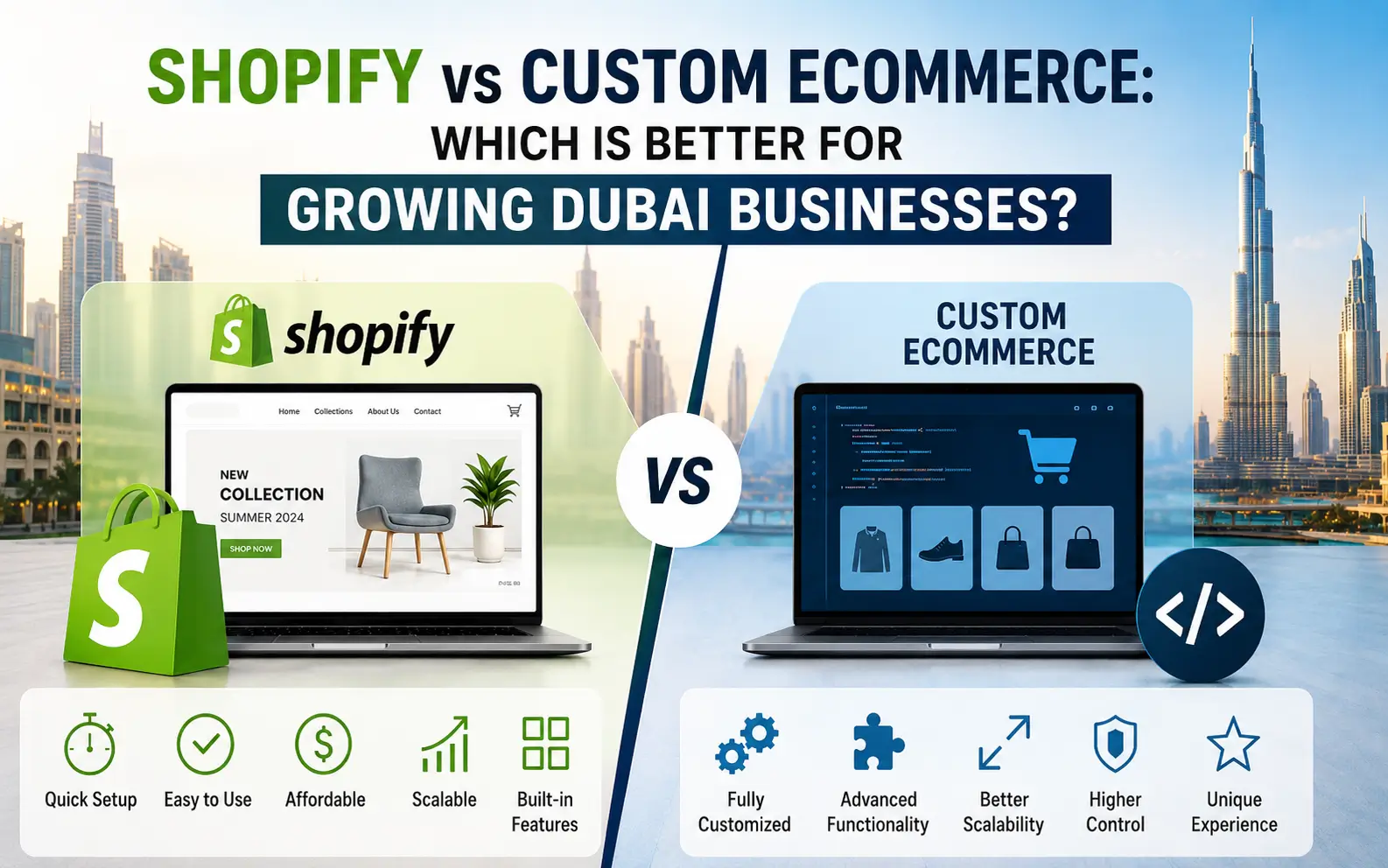
When it comes to selecting an ecommerce platform for a flourishing business in Dubai, the choice is no longer just about technology. It impacts the velocity with which you can launch new products, the way in which consumers perceive your brand, the way that your systems integrate across business and the efficiency of your shop growth.
This is why the Shopify vs custom ecommerce discussion isn’t as easy as the price or flexibility of it.
Shopify provides businesses with a pre-made commerce platform that includes ecommerce capabilities, themes, integrations, an existing development ecosystem, and hosting. Custom ecommerce, on the other hand, provides a business with significantly more control of the architecture, customer journey, functionality and underlying technology.
For Dubai businesses serving demanding customers across the UAE and potentially international markets, the better choice depends on the complexity of the business rather than the popularity of a particular platform.
Why Shopify Is Attractive to Growing Dubai Businesses
The ecommerce landscape in Dubai is fiercely competitive, and speed is a key factor, particularly when it doesn’t affect the experience for the customer. Shopify’s biggest selling point is that it offers a well-developed commerce infrastructure without having to build each of the core features from scratch.
A business can begin on an existing platform, modify the storefront and implement features as the business expands and evolves.
This can be really useful for brands that are looking to release a product, conduct testing and optimise the customer experience without having to wait for months to build ecommerce infrastructure. For growing brands, shopify development services dubai can also provide the technical expertise needed to customise the storefront, connect business systems and improve the shopping experience as the business scales.
Shopify also integrates with business systems like ERP, CRM, PIM and POS systems. When there is no application already in place to fit a specific need, custom applications may be developed. This does not mean that when you opt for Shopify, you have to settle for a totally universal store.
This is an important difference to remember when businesses are thinking about building a Shopify website in Dubai. Professional Shopify development is more than just picking a theme and loading products. The platform can be tailored to the brand’s business needs, customer flow and working environment.
Shopify can be particularly effective when a business needs:
- A faster route to market
Businesses can launch without developing an entire ecommerce infrastructure from the ground up. This is useful for new brands, retailers entering ecommerce and established businesses replacing an outdated store. - A scalable commerce foundation
Shopify can support growing catalogues, integrations, multiple sales channels and more advanced requirements as the business develops. Shopify Plus can also become relevant when enterprise-level requirements demand additional capabilities. - A strong ecosystem for extensions and integrations
Businesses can connect marketing, fulfilment, customer service, inventory, analytics and other systems rather than building every capability internally.
The result is not simply a faster website launch. It can also reduce the amount of technical maintenance that a business needs to manage itself.
When Custom Ecommerce Makes More Sense
Custom ecommerce should not be dismissed simply because Shopify is easier to launch.
There are businesses whose competitive advantage depends on functionality that does not fit comfortably within an established ecommerce platform.
Consider a B2B company with complicated account-level pricing, approval workflows, contract-specific catalogues, unusual quotation processes and deep integration with internal enterprise systems. A custom ecommerce architecture may provide the control required to create exactly the required workflow.
The same can apply to businesses developing highly specialised marketplaces, complex product configurators, subscription models or experiences where the standard ecommerce journey needs to be fundamentally changed.
Sometimes custom development can also be beneficial because the site itself is a key differentiator.
For a luxury retailer in Dubai, let’s say, they might desire a full customisation of a digital journey that spans from editorial to product discovery, personalisation, appointments, customer accounts and various sales channels. Then, the issue isn’t just about a traditional storefront, it’s about building a complete digital commerce ecosystem.
This is where web design Dubai comes into play, which spans beyond aesthetics.
The design should embody the business processes, customer interactions, information architecture, performance requirements, integrations and conversion goals.
Shopify vs Custom Ecommerce: A Practical Comparison
| Factor | Shopify | Custom Ecommerce |
| Initial launch | Generally faster | Usually takes longer |
| Upfront development | Lower in many projects | Typically higher |
| Design flexibility | High with professional customisation | Very high |
| Ecommerce functionality | Mature platform capabilities | Built according to requirements |
| Integrations | Strong ecosystem and APIs | Fully customisable |
| Maintenance | Platform reduces infrastructure responsibility | Business owns more technical responsibility |
| Scalability | Strong for many growing and enterprise businesses | Can be designed around specific scale requirements |
| Unique business logic | Possible through custom development and integrations | Maximum control |
| App ecosystem | Extensive | Needs to be developed or integrated |
| Technical ownership | More platform-dependent | Greater control over architecture |
| Best suited to | Brands wanting speed, reliability and extensibility | Businesses with highly specialised requirements |
An important note from the table is that custom ecommerce does not necessarily mean it’s more scalable, and Shopify does not necessarily mean it’s less flexible.
You need to choose the appropriate one based on what you want to scale.
When there is a need for the business to have more products, customers, marketing campaigns, integrations and sales channels, Shopify can get the business started. If your business requires a completely unique business model, custom architecture may provide more freedom.
What About Ecommerce Design?
The choice of platform only part of the picture.
Even a technologically sound ecommerce platform can underperform, if the website does not offer a user-friendly shopping experience.
This is especially important in Dubai, where the brands appear to be vying in the high-end fashion, beauty, jewellery, electronics, furniture and luxury goods categories.
Customers can do a price comparison between a number of brands before making a purchase. They want fast pages, easy navigation, product information that is easy to understand, mobile-friendly interfaces, and checkout that doesn’t cause undue hassle.
This is why ecommerce web design in Dubai should not be taken lightly but rather as a business approach.
The design must link brand presentation to customers’ actions and measurable results.
The ecommerce experience should allow visitors to easily find products, compare choices, learn about shipping and returns, have faith in the company and make a purchase.
It’s the same process regardless of whether your platform is Shopify or custom-built.
Dubai Businesses Should Think Beyond the Storefront
One of the biggest mistakes businesses make when choosing an ecommerce platform is evaluating only what customers see.
A successful ecommerce operation usually depends on much more than the storefront.
One of the biggest mistakes businesses make when choosing an ecommerce platform is evaluating only what customers see. A successful ecommerce operation usually depends on much more than the storefront. This is where an experienced ecommerce development company can help businesses plan the technology, integrations and functionality around their long-term requirements.
Shopify’s integration ecosystem makes this approach accessible without requiring every connection to be built from zero. Custom ecommerce can also provide deep integration, but the architecture and development effort need to be planned around the business’s specific requirements.
This is particularly important for growing Dubai businesses because the technology decision made today can influence operational efficiency several years from now.
Mobile Experience Should Influence the Decision
Mobile shouldn’t be a last-minute addition for ecommerce brands.
A customer might find out about a product via social media, walk into the store on their smartphone, find it again in a search and then purchase on another device. The site must then be consistent throughout that entire journey.
While Shopify can be a solid platform for mobile commerce, the actual experience will largely depend on the design and development of the store.
When a business has particularly unique needs, a custom ecommerce website will be even more useful in determining how the site looks like on the front end.
The important point is that neither platform automatically creates a high-converting mobile experience.
The implementation matters as much as the platform.
AI and Personalisation Are Changing the Platform Decision
Another consideration for Dubai businesses in 2026 is how their ecommerce technology will support more personalised customer experiences.
AI is increasingly influencing ecommerce through product discovery, content generation, recommendations, customer engagement and other experiences. Shopify itself identifies AI and increasingly personalised customer experiences among the trends shaping ecommerce in 2026.
This does not mean every business needs to build an AI-powered custom platform.
In many cases, Shopify can provide the foundation while businesses connect additional applications, data systems and custom functionality.
Custom ecommerce can provide deeper control where AI functionality needs to be tightly integrated with proprietary business data or highly specialised workflows.
The better approach is therefore to evaluate the actual use case rather than selecting a platform simply because it is marketed as “AI-ready”.
Cost Should Be Measured Over the Entire Lifecycle
Comparing Shopify and custom ecommerce purely on initial development cost can lead to the wrong conclusion.
A custom platform may require a larger initial investment, but that investment can make sense if the business needs functionality that cannot be efficiently achieved through an existing platform.
While Shopify can help lower the burden of the infrastructure businesses need to construct and upkeep, businesses should also consider the costs of hosting, premium applications, custom development, integrations and optimisation.
The more useful question is:
How much will it cost to develop, run, maintain and grow the ecommerce enterprise over the next 3-5 years?
That cost should include development, integrations, maintenance, performance optimisation, security, infrastructure, third-party applications and internal resources required in managing the platform.
So, Which Is Better for a Growing Dubai Business?
Shopify is the app more suitable for many growing businesses in Dubai, offering a proven ecommerce platform that is quick, extensible and has a large ecosystem.
This is especially relevant for retailers, D2C brands and companies in a hurry to validate new products, quickly make the move to ecommerce or modernise their physical stores without adding to the technical burden.
However, that does not make custom ecommerce the wrong choice.
Businesses with highly specialised workflows, complex B2B requirements, unique marketplaces, proprietary customer journeys or unusual operational processes may benefit from a custom-built architecture.
There is also a middle ground.
A business does not necessarily have to choose between a completely standard Shopify store and a completely custom platform. Shopify can be professionally customised, integrated with enterprise systems and extended through custom applications. Meanwhile, businesses with more advanced requirements can explore headless or composable approaches where appropriate.
A Better Way to Make the Decision
Dubai businesses should start with their commercial requirements rather than asking developers which technology they prefer.
Before committing to a platform, evaluate the customer journey, catalogue structure, business model, integration requirements, internal processes, expected growth and long-term digital strategy.
If the priority is launching quickly while maintaining a strong foundation for future growth, Shopify deserves serious consideration.
If the business’s competitive advantage depends on functionality that cannot be delivered efficiently through an existing platform, custom ecommerce may justify the additional investment.
The strongest ecommerce strategy is therefore not about choosing the most powerful technology. It is about choosing technology that solves the right business problems.
Final Verdict
Shopify is often the better choice for growing Dubai businesses that prioritise speed, reliable ecommerce functionality, easier maintenance, integrations and scalable growth. Custom ecommerce becomes more compelling when a business requires highly specialised functionality, complete architectural control or a customer journey that cannot be effectively supported by an established platform.
Quality of implementation must be taken into account in decision making. But a poorly designed Shopify store can perform just as poorly as a poorly engineered custom web site.
Read Also: Sheikh Zayed festival
