
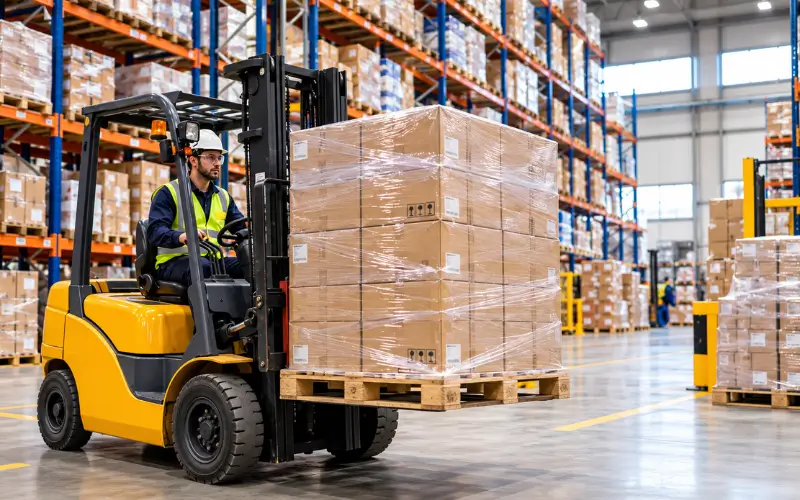
There are various stages that products can go through before they arrive in a store or a customer’s hands. In the process of this travel, even a minor handling error may result in damaged boxes, broken goods, and higher costs. This risk is increased when a forklift is used more than once.
The use of robust pallets, training forklift operators, defining product handling procedures, and inspecting products at every transfer point are all measures that can be implemented at distribution centres to minimize product damage. They should also optimize the warehouse layouts, secure loads, and apply appropriate packaging. Crateco Pack LLC, a trusted plastic pallet supplier in Dubai, can help businesses find suitable pallets for safe lifting, stable stacking, and repeated warehouse use.
Key Strategies to Prevent Product Damage During Forklift Transfers
1. Choose Strong Pallets for Repeated Forklift Transfers
Pallets support the load of products when storing and transporting them. If the pallet is bent, cracked, or broken when being lifted, the contents of the pallet can fall off or be damaged. The first step to safer handling is selecting the proper pallet.
The load weight, product type, storage requirements, and the number of moves a pallet will see should be taken into consideration. Plastic pallets can be helpful in fast-paced distribution centers as they are moisture resistant, harder to splinter than wood, and can be easily cleaned.
Match Pallet Design to the Load
Not all pallets are capable of the same load. Light Box pallets may not be appropriate for machine parts or stacked drinks. Always verify the safe loading capacity of the pallet prior to use.
In addition, ensure that its size is suitable for the goods and forklift equipment. A good pallet will provide a balanced load and minimize the risk of a load shifting during repeated handling.
2. Train Forklift Operators in Safe Handling
Forklift operators are a key factor in the prevention of product damage. Boxes can fall or move if the people lifting them lift them in an improper way, make sudden turns, or have rough stops. Workers need to be trained in safe lifting, moving, lowering, and placing loads.
Operators should be aware of the weight capacity of the forklift and know how to maneuver the various types of loads. Workers are familiar with safe procedures through ongoing training and skill checks, even in hectic work schedules.
Avoid Sudden Movements
Forklifts should operate at a safe speed, particularly when loading fragile or uneven items. Avoid using sharp turns, hard braking, and sudden changes of direction. Lift a fork completely under the load, and the load must be stable before lifting.
When workers place goods on racks, trucks, or other pallets, they should lower them gently. Shocks that can damage products during each transfer can be minimized with these simple steps.
3. Secure Products Before Moving Them
The only way to avoid damage to strong pallets is to make sure the items on them aren’t loose. Also, boxes can slide, drop, and jam together when a forklift starts, stops, or maneuvers. Materials should be secured to prevent movement with appropriate wrapping, straps, corner guards, etc., from distribution centers.
The right method is dependent upon the shape, weight, and fragility of the goods. A stable load is less likely to be damaged and easier to move.
Use the Right Wrapping Method
The stretch film can be used in boxes for fixation and to eliminate movement when handling. Wrap, however, should not be too loose nor too tight. Over-filling can cause weak cartons to collapse, and loose wrapping can cause contents to shift.
Lighter items should be above the heavier ones, and the heavier items should be placed at the bottom. Products that could be damaged should be well padded and not be used to support other items. Before any large movement, workers should inspect the load.
4. Improve Warehouse Layout and Transfer Routes
When there is lots of clutter in the warehouse, there is a greater likelihood of collisions, sudden turns, and dropped loads. In the distribution centre, clear routes for forklifts should be established and, wherever possible, walking areas separated from forklift areas.
Safeguarded space for safe movement at storage racks, loading zones, and transfer points. Signs and floor markings can be used to inform workers where to drive and where to position goods.
A clear layout minimizes handling and facilitates operators moving products without bashing walls/shelves and other products.
Reduce Unnecessary Transfers
Each additional strike offers another opportunity to take damage. It is advisable to evaluate the movement of goods from receiving areas to storage, picking areas to packing areas, to shipping dock areas.
They should make plans to avoid handling the same pallet multiple times wherever feasible. When space and safety permit, locate goods that need to be picked or shipped quickly near appropriate picking or shipping points.
The fewer the transfers, the more time will be saved, the fewer labor costs incurred, and the fewer products damaged.
5. Check Pallets and Forklifts Regularly
Damaged equipment can cause a normal transfer to become a costly accident. Unstable loads can result from cracked pallets, loose parts on the forklift, worn tires, and/or faulty lifting systems. The distribution center should establish an easy forklift and pallet inspection process.
Any problem should be reported before re-using the equipment. Frequent inspections allow small problems to be identified at an early stage and help minimise the risk of failure when goods are being transported.
Remove Damaged Pallets from Use
Employees should inspect the load before lifting for any cracks, broken parts, bent sections, or any other indications of wear. Damaged pallets should be marked and set aside for examination/replacement.
Forklift inspections should include forks, brakes, steering, tires, and lifting controls, per the equipment manufacturer’s directions. If the equipment is not used due to its defects, it can prevent damage to the employees, products, and warehouse facilities.
6. Use Packaging That Matches the Product
Packaging protects a product from the shocks it may encounter when being handled. Heavy objects might require special packing methods, such as foam inserts or dividers, or just be wrapped in thin cardboard. Fragile items may require foam inserts, dividers, or additional padding.
Packaging should be evaluated at the distribution centre level in terms of product weight, shape, and sensitivity. The packaging should also be appropriate for the number of times in which loads are to be moved. Damage such as scratches, broken parts, crushed boxes, and more can be prevented through better protection.
Protect Fragile and Heavy Items
Delicate items such as glass, electronics, ceramics, and other items require special care. Use inner supports to prevent items from moving inside their boxes. For heavy products, use strong cartons or appropriate containers that are able to withstand stacking pressure.
Avoid putting breakable goods under heavy loads and do not leave gaps where goods can be moved. If the products are oddly shaped, they can be provided greater protection by using custom supports instead of standard boxes.
7. Control Stacking Height and Load Weight
Even if operators are careful with stacking, they can cause damage to the products. Excessive stacking heights can cause the load to become unstable or offload while being handled. Too much weight may cause cartons in the bottom to crush, and the uneven stacks can lean and move.
Clear guidelines for the height of stacks, weight of loads, and how they are stored should be established in distribution centers. These rules should be based on the limits of the products, pallets, rack design, and safe working limits of the handling equipment.
Keep Loads Balanced
Distribute weight evenly on the pallet, rather than putting it on one side. Maintain the balance of the load and prevent items from being overhung from the edges of the pallet.
Lifting and lowering uneven loads may cause them to shift and cause damage. Racks should not be loaded beyond the limits indicated and should never be loaded so that it interferes with the operator’s visibility or poses an unsafe delivery.
Conclusion
Improved pallet quality, operator training, packaging, warehouse layout, and equipment checks are ways distribution centers can minimize damage to products during multiple forklift transfers.
They are responsible for making sure that all loads are secured, the stacking height is controlled, unnecessary moves are minimized, and damage is recorded at each step. Businesses can select plastic pallets from a trusted supplier that can provide solutions that help them select suitable pallets for their products and handling requirements. These steps can help warehouse teams ensure safe transit of goods, minimize waste, avoid additional expenses, and safeguard the product from the point of receipt to delivery.
Read Also; Al Jafiliya Immigration Dubai
