

You will not just be sending your child to school in the UAE, you are sending him or her to a school.You are not just sending your child to school in the UAE, you are sending your child to a school. Most private schools will have a Parent School Contract which is signed by the parent/legal guardian and the school that defines the responsibilities, rights, and expectations of both the parent/legal guardian and the school.
This contract provides a clear understanding of the relationship between parents and schools and sets out some important issues like why they pay tuition, the expected attendance, the expected behaviour, how they will be kept informed, what they are expecting to learn and the policies to be followed. Both parties agree to sign an agreement which recognizes both parties’ responsibilities and commits them to supporting the child’s learning.
The Parent School Contract is crucial in understanding, regardless of the school in Dubai, Abu Dhabi, Sharjah or any other emirate your child is enrolled in. This guide provides an overview of the agreement, its implications and what parents should be aware of before signing the agreement.
What Is a Parent School Contract in the UAE?
Parent School Contract is a written contract between a school and a parent/legal guardian. It outlines the conditions and requirements for the students’ enrolment, outlining the role and responsibilities of the school and the family.
The agreement will aim to set out why the school is set up and what is expected from parents throughout the school year which will help to avoid misunderstandings.
While the format can differ from school to school, most contracts will have a section on the following topics:
- Information on tuition and payment.Details about tuition and payment.
- Attendance requirements
- Students’ discipline and behaviour
- Academic expectations
- School communication policies
- The measures implemented for health and safety.
- If applicable, transportation rules will be included in this listing.
- Uniform requirements
- Data Privacy & Consent
- Please see the Withdrawal and refund policy for details.
The Parent School Contract is not a form of paperwork, but a model of working together between the school and the family in order to provide a supportive learning environment for children.
Why Is the Parent School Contract Important?
By setting expectations in the Parent School Contract at the start of school, the contract is advantageous to both the school and families.
For parents it provides information about the type of services the school will offer, how they will communicate with you and what you are expected to do. From a school perspective, it is essential that families are aware of and accept school’s policies prior to confirmation of enrolment.
There are many advantages to this, such as:
- Encourages good lines of communication between parents and school.
- Minimises conflict by setting out agreed policies and procedures.
- Looks after the interests of both sides.
- Encourages the pupil’s learning and personal growth.
- Promotes student-family engagement in learning.
Once everyone knows their role, it will be easier to establish a good partnership in the best interests of the child.
Is a Parent School Contract Mandatory in the UAE?
Parents will usually be asked to sign a Parent School Contract when enrolling their children at private schools in the UAE, or when they re-enrol at the school. Specific requirements may vary from emirate to emirate, and from one school to another, depending on the governing authority of the school.
Generally, the authorities which govern the schools in Dubai, such as the Dubai education regulator, or Abu Dhabi’s education authority, will have a policy stating the terms and conditions of the school before the enrolment of a student is finalized, and the parents will have to agree to and accept those terms and conditions.
There may be other policies that apply to public schools but won’t be included, and international schools will have other policies that may apply to their curriculum or governing organization.
Parents should read through each clause of the agreement and seek clarification from the school prior to signing.
Who Needs to Sign the Contract?
In most instances the Parent School Contract will be signed by:
| Party | Role |
| Parent | Accepts the school’s terms and responsibilities. |
| Legal Guardian | Signs if responsible for the student’s education. |
| School Representative | Confirms the school’s commitment to the agreement. |
There may be some schools that will have additional obligations for older students to sign and accept certain policies of behavior and/or technology use, but again, this is typically a contract between the school and a parent or guardian.
What Does a Parent School Contract Usually Include?
Although each school will have its own policies, most Parent School Contracts will have the following sections:
| Section | Purpose |
| Admission Terms | Conditions for student enrolment. |
| Tuition Fees | Payment schedules, due dates, and late fee policies. |
| Attendance | Expectations for regular attendance and reporting absences. |
| Behaviour | Student conduct, discipline, and code of ethics. |
| Communication | How the school and parents will communicate. |
| Health & Safety | Medical information, emergency procedures, and safeguarding. |
| Technology | Acceptable use of school devices and internet services. |
| Privacy | Handling of student records and personal information. |
| Withdrawal | Procedures for leaving the school and possible refund rules. |
Carefully reading these sections can make parents aware of their responsibilities before signing.
How Does the Contract Benefit Your Child?
Creating a learning environment isn’t all about policies – it’s about a Parent School Contract. Together with clear expectations, a collaborative partnership between parents and schools has a positive impact on students’ success in school, positive behaviour, and supports students at home and at school.
The agreement also supports regular contact to be able to discuss issues at an early stage easier and to keep the child’s learning needs top of mind.
Parent, School and Student Responsibilities in a UAE Parent School Contract

A Parent School Contract is particularly effective if it is clear what is expected of all concerned in the education of a child. Private schools usually define the duties of parents, schools and students from the start of the school year in the UAE.
This section is significant as many arguments are founded on misunderstandings regarding fees, attendance, communication, behaviour and/or academic expectations. It’s important for parents to read through these clauses carefully to prevent issues in the future.
Parent Responsibilities
Typically parents/legal guardians have multiple responsibilities under the Parent School Contract. The roles are designed to assist the child in his or her learning and help to facilitate communication with the school.
Common parent responsibilities include:
- Making timely payment of tuition and other allowable fees.
- Making sure the child goes to school regularly and on time to class.
- Reporting absences, medical conditions or changes to the school.
- Helping the child to do their homework, assignments and studies.
- Participating in parent-teacher conferences as called for.
- Adhering to school policies for behaviour, uniform and transport and communication.
- Answering to school announcements and/or notices.
Example of a parent obligation
Example:
Parents may be asked to inform the school if their child is absent and give a reason for their absence. If the above continues the following consequences may ensue per school policy: warning(s) and/or additional consequence(s).
School Responsibilities
The contract also specifies the responsibilities of the school. This can enable parents to know the quality of education, safety and support that they can be assured of.
Common school responsibilities include:
- Implementing the adopted curriculum in the provision of education.
- Ensuring safety and security in school.
- Providing well-qualified teachers and staff.
- Ongoing assessment of student’s work.
- Providing information to parents with meaning.
- Implementing policies for discipline fairly and consistently.
- Ensuring pupils’ well-being and anonymity.
Example of a school obligation
Example:
The school may need to give regular academic reports and advise parents if there are concerns regarding the student’s academic progress, attendance or behaviour.
Student Responsibilities
While the legal document typically is signed by the parent/guardian, many contracts include expectations for students as well.
Common student responsibilities include:
- Attending classes regularly.
- Completing homework and assignments.
- Respect for teachers, staff and classmates.
- Obedience to the school Policy.
- Appropriate utilization of school equipment.
- Abiding by technology and internet usage guidelines.
Parent vs School Responsibilities
| Parents | School |
| Pay fees on time | Provide agreed educational services |
| Ensure attendance | Maintain attendance records |
| Support learning at home | Monitor academic progress |
| Communicate with the school | Provide timely updates |
| Follow school policies | Apply policies fairly |
| Provide accurate information | Protect student welfare |
Common Clauses in a Parent School Contract
There are a number of general clauses that are commonly included in most UAE private school contracts. It is important to know these clauses before entering into an agreement.
Tuition fees and payment schedule
This section explains:
- Annual Tuition.
- Installment dates.
- Accepted payment methods.
- Late payment penalties.
- Additional approved charges.
Important
Parents should confirm in the contract if there are rules to refund if the student leaves the school during the school year.
Attendance and punctuality
The schools typically require pupils to attend regularly. The contract can provide an explanation of:
- The way absences are to be reported.
- Criteria for excused absences.
- The impact of habitual unauthorised absences.
- Expectations for arriving on time.
Behaviour and discipline
The school expects the following behaviour from students:
- Respectful behaviour.
- Bullying policies.
- Use of inappropriate language.
- Damage to school property.
- Consequences for misconduct.
Communication with parents
The contract can outline the way in which the school will communicate the following, such as:
- Email notifications.
- School apps or school portal.
- SMS messages.
- Parent-teacher meetings.
- Academic reports.
Technology and social media
In many schools today there are policies regarding:
- Use of school devices.
- Internet access.
- Online learning platforms.
- Social media behaviour.
- Digital safety.
Health and safety
This section may cover:
- This section can include:
- Medical information.
- Emergency contacts.
- Medication procedures.
- Accident reporting.
- School safeguarding policies.
Transportation
If bus services are offered by the school, contract may contain:
- Pick up and drop off regulations.
- Bus fees.
- Student behaviour on the bus.
- Parents’ duties for the collection of their children.
Withdrawal and refunds
One of the most crucial parts describes:
- How much notice is to be given before withdrawal.
- If tuition fees are refundable.
- Administrative charges.
- Conditions for transferring to another school.
Real-Life Example of a Contract Clause
Example:
A school can require payment of tuition fees prior to the beginning of each term. The school reserves the right to impose a late fee if payment is late, and to withhold use of certain services until payment is made.
It is not to say that the school has no right to be unfair but it exemplifies the reasons why parents should know the terms of payment before signing.
Why This Section Matters
While parents may be mostly concerned with the admission and fees, the responsibility section is as significant. It details the school’s expectations of parents supporting attendance, behaviour, communication and academic progress.
Being aware of these responsibilities will reduce misunderstandings between parents and the school, and can help foster a more positive relationship.
Parent Rights, Dispute Resolution & Tips Before Signing
When parents sign a Parent School Contract, they will have rights as well as responsibilities. It can empower families to be confident in their communication with the school and to be aware of what to expect during their child’s schooling.
Parents should read through each clause of an agreement before signing, and if they are not sure, ask any questions that come to mind; they should keep a copy of the agreement signed for future reference.
Parent Rights Under a School Contract
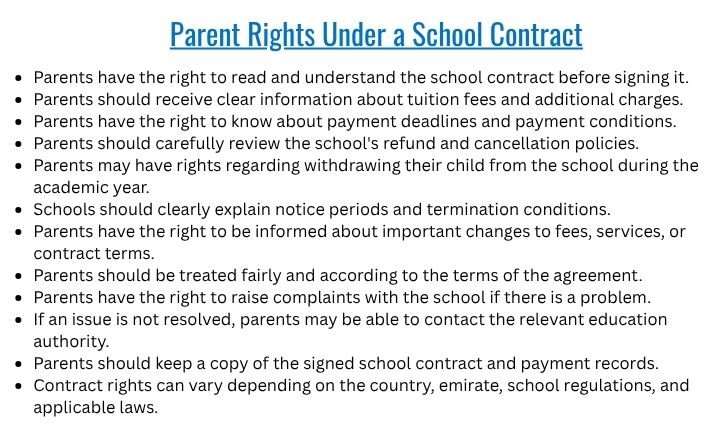
The Parent School Contract is designed to safeguard the school and the family. Schools have policies in place to keep the school safe, and the School has a duty to inform parents and treat them fairly.
Overall, parents are entitled to:
- Get correct details of tuitions and other approved charges.
- Be informed about their child’s academic performance and behaviour.
- Attend parent-teacher meetings.
- Express concerns/complaints in the formal school manner.
- Be notified of events and policies of importance to school.
- To find that her/his child will get the education in a safe and supportive setting.
- Obtain school attendance, discipline and student welfare policies.
The rights may differ slightly from one school to another according to its policies as well as the emirate where it is situated.
What Happens If the Contract Is Not Followed?
The parent and school should agree the terms, and if they are not met, the matter is normally dealt with within the school system, rather than by the parent or school.
For example:
If parents do not meet their responsibilities
This may include:
- Inconsistent payment of tuition fees.
- Regular unexplained pupil absences.
- Inability to abide by key school policies.
- Giving bad or wrong contact details.
This might result in reminders, meetings and/or other administrative actions, depending on the policy of the school.
If the school does not meet its responsibilities
Parents can raise concerns if they feel the school has not provided the services/support agreed to in the agreement.
Common concerns include:
- Lack of communication.
- Safety issues.
- Academic concerns.
- Failure to adhere to published policies.
- Unresolved complaints.
Usually, schools will invite parents to talk to the teacher or school management about their concerns before referring it to the next level.
How Are Disputes Usually Resolved?
The majority of schools have a formal grievance process in place to fairly and professionally address complaints.
The usual procedure is as follows:
| Step | Action |
| 1 | Discuss the issue with the class teacher. |
| 2 | Contact the school coordinator or head of department. |
| 3 | Meet with the school principal if the issue remains unresolved. |
| 4 | Follow the school’s official complaints process. |
| 5 | Contact the relevant education authority if necessary. |
Open communication is a fast and efficient way to address concerns.
Education Authorities in the UAE
Depending on the emirate, private schools in the UAE are supervised by education authorities.
Examples include:
| Emirate | Education Authority |
| Dubai | Knowledge and Human Development Authority (KHDA) |
| Abu Dhabi | Abu Dhabi Department of Education and Knowledge (ADEK) |
| Sharjah & Northern Emirates | Ministry of Education (for many schools) |
These powers are regulatory and ensure that private schools provide education that meets standards and requirements.
Tips Before Signing a Parent School Contract
Take time to read through the agreement carefully before signing. When you’re reading a contract, it’s important that you understand it at this point so you don’t have any misunderstandings later on.
Read Every Section
Read all terms and conditions, including the fine print, in the contract before signing.
Understand the Fee Policy
Check:
- Tuition payment dates.
- Additional charges.
- Refund rules.
- Withdrawal procedures.
- Late payment policies.
This information can prevent you from having unnecessary expenses.
Review Attendance Requirements
Be sure to understand:
- How absences should be reported.
- Attendance expectations.
- How to apply for leave.
Ask Questions
If you see anything that you don’t understand in the agreement, seek clarification from the school prior to signing.
Examples include:
- Do you have any other annual costs?
- What if we change to another emirate?
- How do complaints get dealt with?
- What support is provided to student?
If a reputation school isn’t happy to discuss its policy in detail, it’s not a good idea.
Keep a Signed Copy
Always retain a copy of the signed contract, either electronically or in hard copy!
It can be helpful if there are questions about:
- Tuition payments.
- School policies.
- Communication records.
- Student enrolment.
- Withdrawal procedures.
Common Mistakes Parents Should Avoid
By understanding the contract before signing on to it many issues could be avoided.
Common errors are:
- Failing to read the entire contract before signing.
- If all schools have the same policies, then:
- Not taking the time to follow-up on refund and withdrawal rules.
- Making late tuition payments.
- Not updating emergency contact information.
- Not attending parent-teacher conferences.
These are the pitfalls to be avoided in order to foster a positive relationship with the school.
Why Parent-School Cooperation Matters
A Parent-School Contract is not just a piece of paper, it is a partnership between parent and school that concentrates on the child’s success.
Regular communication between parents and school; sharing of responsibilities; tackling issues early will enable students to flourish with regard to learning, social and emotional development.
A strong partnership also helps children to learn to study well, behave well and gain in confidence throughout their school career.
Key Takeaways
| Topic | Summary |
| Purpose | Defines the responsibilities of parents and schools. |
| Parents | Support learning, pay fees, maintain communication, and follow school policies. |
| Schools | Provide quality education, maintain safety, and communicate with families. |
| Students | Attend regularly, follow school rules, and respect others. |
| Before Signing | Read the contract carefully, understand fees and policies, and keep a copy. |
Conclusion
Many private schools in the UAE have a Parent School Contract as an essential component of the admissions process. It sets clear expectations for parents, schools, and students, fostering a clear and supportive learning atmosphere.
Parents need to familiarise themselves with the terms of the contract, including the tuition fees, attendance, behaviour, communication and withdrawal policies. Later on, it can cause confusion if you don’t ask questions and have a signed copy of the agreement.
The bottom line is that parental involvement and school unity are critical factors in a child’s school success. Through collaboration and performing their individual roles, both parties can assure students a positive and productive learning environment in a safe learning atmosphere.
FAQs
What is a Parent School Contract in UAE?
Parent School Contract is a written agreement between a school and parent/legal guardian. It sets out clear duties, rights and expectations of the parties relating to the education, attendance, fees, behaviour and communication of a student.
Does UAE require Parent School Contract?
Parents/legal guardians are asked to sign a Parent School Contract at the time of admission/re-enrolment in most schools in the UAE. This may differ from school to school based on school policies and emirate.
Who is the one who signs the Parent School Contract?
The contract is typically signed by a parent or legal guardian and an authorized representative of the school. Sometimes, older students can recognize certain school policies also.
Do parents have the ability to negotiate the terms of the contract?
Parent School Contracts are based on standard school policies; however, prior to signing, parents may have questions or request clarification. The school may be contacted for some administrative issues.
What is the consequence of late payment of tuition fees?
The ramifications are dependent on the school’s fee policy. Late fees or administrative action as specified in the contract may be applied by some schools.
Before parents sign, what should they do?
It is important for the parents to thoroughly read each section, understand the fees, read through the refund policies, and if anything is not clear, ask questions and then keep a copy of the signed agreement.
Can a student be withdrawn after signing the contract?
Yes. But it is important for parents to abide by the school’s withdrawal rules including any notice periods and financial requirements outlined in the contract.
