
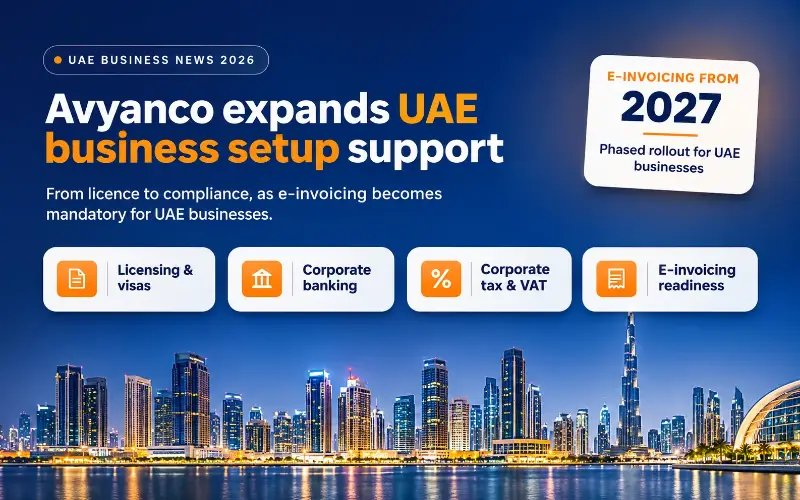
Dubai-based business setup consultancy Avyanco has broadened its support for foreign investors entering the UAE, adding e-invoicing readiness to a service range that already spans licensing, visas, banking, tax and compliance. The move comes as the UAE prepares to make electronic invoicing mandatory for large businesses from January 2027, a change that will affect new and existing companies alike.
For international founders, the timing matters. Setting up a company in the UAE no longer ends with a trade licence. Corporate tax registration, VAT obligations and now a national e-invoicing system mean that compliance planning has become part of the setup process itself, rather than something to deal with in the first year of trading.
A Market That Keeps Drawing International Founders
UAE is still one of the busiest countries for foreign company registration. Most mainland businesses are now fully owned, over 40 free zones provide licenses for specific activities and the corporate tax regime is 9% for income over AED 375,000, with a 0% rate for qualifying free zone persons on eligible income.
Dubai also has been decreasing the time required for a new business to be up and running. In November 2025, Dubai Business Registration and Licensing Corporation (DBRL) under the Department of Economy and Tourism (DET) announced the Dubai Unified Licence (DUBE) has reduced the time it takes to open a business bank account from 65 days to approximately five, by directly integrating with banks such as Emirates NBD, Mashreq and First Abu Dhabi Bank. A new Free Zone Mainland Operating Permit, introduced by Executive Council Decision No. 11 of 2025, has been issued to qualifying free zone companies to conduct certain non-regulated business activities on the Dubai mainland, for a six month period, which is renewable.
With these changes, the UAE became more accessible, yet more options. Investors are now considering the mainland versus free zones, as well as how a structure will harmonize with tax, invoicing and access policies over time.
Avyanco’s Business Setup Support
Avyanco is established in Dubai in 2020 and is located at Burj Al Salam Tower on Sheikh Zayed Road, Dubai, UAE serving clients in the UAE including entrepreneurs, start-ups, SMEs and established groups. It serves clients throughout Dubai, Abu Dhabi, Sharjah and Ras Al Khaimah and has over 45 free zones in which it operates, such as DMCC, IFZA, JAFZA, DAFZA, DIFC, Meydan and ADGM.
The setup services include that of mainland, free zone, offshore structures, trade name reservation, initial approvals, issuing the licence, drafting the memorandum of association, applying for establishment cards, investor visa and employee visa, and processing Emirates ID. A PRO team takes care of government liaison, document clearance and attestation which enables most of the process to proceed even before a founder moves in.
Once the firm is incorporated, it helps them with applications for corporate bank account, corporate tax and vAT, bookkeeping, payroll and WPS, audit and UBO applications. For more sophisticated requirements it advises on holding companies, SPVs, family foundations and transfer pricing. Its e-invoicing support was launched in October 2026, to ease businesses’ understanding of their obligations and prepare their invoicing processes ahead of the national deadlines.
How Companies Are Formed in Dubai
For most investors, company formation in Dubai begins with one decision: where the business will operate and who its customers will be. A mainland licence, granted by the Department of Economy and Tourism enables a company to deal directly with customers in any part of the UAE and to tender for government contracts. A free zone licence is ideal for international trade, consultancy, technology and ecommerce companies, and is often packaged with an office or flexi desk package. The offshore entities are mainly holding companies that are not used for trading.
It then depends on the nature of the business activity, which will dictate which licences and approvals are required. Certain activities require a sector regulator’s approval before a licence is granted, for example, financial services, healthcare or education. Early planning of visa numbers is also required as the number of residence visas that can be sponsored for a company can be dependent on office space and the type of licence.
Understanding the Cost of Starting Up
One of the main source of confusion for foreign founders is the variance of costs. The business setup cost in Dubai depends on the jurisdiction, the activity, the number of visas, office requirements and any external approvals. The published cost guide on Avyanco includes the typical government fees for a company making up one owner with only 1 Visa, which total between AED 12,000 and 22,000, excluding professional fees and office rentals outside of the package price.
In the range, the most significant variable is the trade licence, which is either determined by the free zone that is chosen or the mainland authority. There are some additional, one-off fees, such as establishment cards, investor visas, medical tests and Emirates IDs, as well as the costs of employer visas on the mainland which generally tend to be more expensive as they also include a labour card. When comparing quotes, investors are recommended to distinguish between three categories: the government fee, the fee and other ongoing expenses of the service provider, like annual licence renewal, visa renewal, accounting and tax reporting.
Latest 2026 Updates Investors Should Track
The biggest change in compliance is right around the corner: e-invoicing. A pilot of the selected taxpayers started on 1 July 2026 under Ministerial Decisions printed in September 2025. The businesses with an annual turnover of at least AED 50 million had to appoint an Accredited Service Provider by 31 July 2026, and will have to adopt the system from 1 January 2027. These businesses will have until 31 March 2027 to appoint a provider, and will be required to be live from 1 July 2027.
In the case of new companies, this implies that systems have to be selected from the beginning with the national system being taken into consideration. The requirement, together with deadlines for corporate tax registration and VAT thresholds, puts post-setup compliance planning firmly in the spotlight, rather than the back.
Outlook
The UAE has been more welcoming to foreign founders with its efforts to reduce the time to license and bank, and new tax and invoicing regulations have added to the need for a proper start-up structure. Companies that offer set up and banking and compliance assistance are well placed to assist investors during both aspects of that transformation. Avyanco’s Dubai offices continue to service companies that are entering and expanding in the UAE with a wider service scope.
Disclaimer: This content is for informational purposes only. Details may change over time. Readers should verify information with official sources before making any decisions
Read Also: Al Mirfa Abu Dhab
