
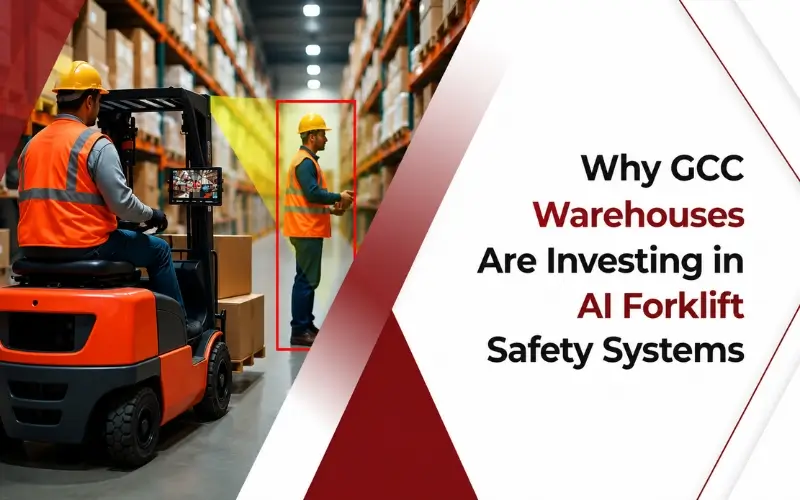
Warehousing is booming across the GCC, and forklifts remain one of the highest-risk assets on any floor. Operators are moving past manual checklists toward AI-driven protection that detects pedestrians, eliminates blind spots, and logs incidents automatically. This article covers the region’s growing risk profile, the forces driving the shift, how these systems work, the benefits for operators, what to look for when buying, and why AI safety is fast becoming a baseline warehouse standard.
Table of Contents
- Introduction
- The Growing Risk Profile of GCC Warehouses
- What’s Driving the Shift to AI Forklift Safety Systems
- How AI Forklift Safety Systems Actually Work
- Key Benefits for GCC Warehouse Operators
- What to Look for in an AI Forklift Safety System
- The Road Ahead: AI Safety as a Warehouse Standard, Not an Option
- Conclusion
- FAQs
The UAE, Saudi Arabia, Qatar and the rest of the GCC’s warehousing boom does not appear set to slow any time soon. The area is transforming its logistics infrastructure with new distribution hubs, fulfilment centres and industrial parks opening up at speed. However, on each of those floors, the forklift is still one of the most dangerous assets in play – fast, heavy and populated with people. With the growing size of fleets and the length of shifts, operators are beginning to realize that relying on checklists and simply meaning well won’t do. The answer is a clear step towards AI forklift safety systems that always observe and have already acted before incidents happen. This article explores why that change is occurring, how these systems operate and what to watch for.
The Growing Risk Profile of GCC Warehouses
Growth is the driver of the risk. Logistics and e-commerce are flourishing rapidly in Dubai, Riyadh and Jeddah, making them key distribution hubs in the region in little time. That success means larger fleets, narrower aisles, and multi-shift work around the clock — and all these contribute to more workers being around moving forklifts.
Data from all over the industry has found that forklifts cause a large number of serious injuries in warehouses around the world, and “struck by” is one of the most frequently occurring and severe injuries. A complex problem is magnified through scale: a control is effective on a small team but proves ineffective on a large, busy site. It is this, amongst other reasons, why traditional approaches are inadequate. The need for constant human attention at the wrong time with operator training, floor signage and mirrors is a liability at the GCC scale. In the Middle East, robust warehouse safety solutions are increasingly in need of a non-blinking eye.
What’s Driving the Shift to AI Forklift Safety Systems
1. Rising Operational Costs of Accidents
A serious incident usually doesn’t cost one time. It causes delays as business becomes inoperative, equipment damage, increased insurance rates and the risk of compensation claims. The costs add up, and forklift accident prevention technology seems more like a defensive move than a cost, across a well-busy facility.
2. Regulatory & Compliance Pressure
Gulf labour and occupational safety authorities are gradually increasing their efforts to inspect and enforce, and the trend is toward internationally accepted standards. ATEX certification and OSHA-compliant practices are emerging as reference points for what “good” looks like, and are setting the bar high for industrial safety technology both in the UAE and in Saudi Arabia.
3. Labour & Skills Gaps
The region’s warehouses have transient, multinational staff of varying experience. That’s where safety systems that can lower the necessity of relying on the skill of one particular operator are extremely beneficial — a forklift pedestrian detection system is valuable to everyone, regardless of their length of service.
4. Insurance & Risk Management Incentives
Insurers are now offering incentives for placing proactive safety technology at a site, understanding that it also reduces the exposure to the insurer. That means smart warehouse safety solutions for operators are a real cost savings opportunity – instead of waiting for an incident to drive the change.
How AI Forklift Safety Systems Actually Work
Today’s systems integrate cameras, sensors and AI into one layer of constant awareness. The key to real-time object and pedestrian detection is an AI forklift camera system that recognizes people and obstacles and can separate them from background clutter. Those around the vehicle have 360° camera coverage for true forklift blind spot detection, eliminating struck-by accidents.
The intelligence is reflected in the answer. These systems deliver automatic warnings – proximity warnings as an object approaches and speed-control warnings in heavy traffic zones – and even geofencing to ensure safe behaviour in designated areas. Many also connect with warehouse management systems (WMS) where incidents and near-misses are logged for managers to review and react to patterns. In real warehouse environments, these features are applied, such as SharpEagle’s AI Forklift CCTV Solutions and Forklift Reverse Sensor and Radar Detection Systems, which combine vision with radar to provide reliable coverage in challenging environments.
Key Benefits for GCC Warehouse Operators
The benefits add up in terms of safety and cost savings. Most immediately, a forklift collision avoidance system prevents collisions or near-collisions, which decreases the number of collisions at a site. That reduction directly goes into lower insurance premiums and liability exposure, as insurers will keep proactive sites at a lower price.
Plus, there’s an administrative advantage – automatic logging creates more robust compliance paperwork and audit trails, making safety more of a paper trail you can back up. However, the operational impact of fewer incidents is improved throughput and fewer stoppages, and a visibly safer working environment will help to instill confidence in the workforce, which can have a significant impact on retention – a critical element in the competitive regional labour market.
What to Look for in an AI Forklift Safety System
Not all systems are appropriate for the Gulf environment, so the specification becomes important. ATEX or explosion-proof certification is essential for oil & gas refinery, petrochemical and many industrial locations in the GCC region — it’s not simply a standard option. Important too is excellent local support and after-sales in the region, with problems being solved fast, rather than being sent out of the country.
Practicality counts too. Check whether the forklift safety technology works well with the current fleet, as there is the option of retrofitting existing machines without replacing the entire fleet. Ensure compatibility with existing fleets because forklift safety technology in the UAE and elsewhere that is retrofit friendly allows operators to upgrade existing vehicles without having to replace the entire fleet. Also demand durability for high heat, dusty Gulf environments. SharpEagle’s forklift safety system, camera and sensor packages are designed with ATEX certification and in-house manufacturing for the high industrial environment that is prevalent throughout the region.
The Road Ahead: AI Safety as a Warehouse Standard, Not an Option
The course of action is clear. What used to be a differentiator is quickly becoming a requirement that is included in tenders, and it is being called for in audits. Winning warehouse contracts is more an expectation than a promise, as this level of protection is increasingly expected.
The future is in sight: predictive analytics that identify risk patterns before they can impact the safety of the fleet, and fleet-wide safety dashboards that provide real-time, site-wide visibility of behaviour and exposure to fleet managers. In the GCC, warehouse automation safety is moving from periodic to continuous checks and monitoring through data.
Conclusion
Safety is the goal for all GCC warehouses — and it’s the direction it’s trending. All GCC warehouses are making AI-driven safety a priority, not just recording incidents. Those operators now investing are safeguarding their people, throughput and reputation in a volatile market. To see how this will impact your facility, check out SharpEagle’s forklift and MHE safety solutions or ask for a consultation with their staff.
FAQs
Q1: What is an AI forklift safety system?
It’s a technology which leverages AI cameras and sensors to monitor pedestrians and obstacles in real time, reduce blind spots and automatically alert for forklift collisions.
Q2: Why are GCC warehouses prioritizing forklift safety now?
Exponential logistics growth has expanded fleets and increased operational activity, and new regulations, escalating accident costs and labour shortages are making proactive, technology-based safety more urgent than ever.
Q3: Are AI forklift safety systems compatible with existing fleets?
Yes. Most quality systems are retrofit solutions designed to be installed on existing forklifts with little or no modification, giving operators a choice to upgrade existing units instead of having to replace their entire fleet.
Q4: Do AI forklift safety systems help with regulatory compliance?
Yes. They help to ensure compliance by ensuring safer behaviour and automatically recording incidents and near-misses, providing clear audit trails in line with increasingly stringent Gulf and international safety regulations.
Q5: How long does it take to install an AI forklift safety system?
Installation time varies depending on fleet size, system complexity and site requirements; however, retrofit-friendly systems can be installed quickly – typically per vehicle, without extensive fleet downtime.
