
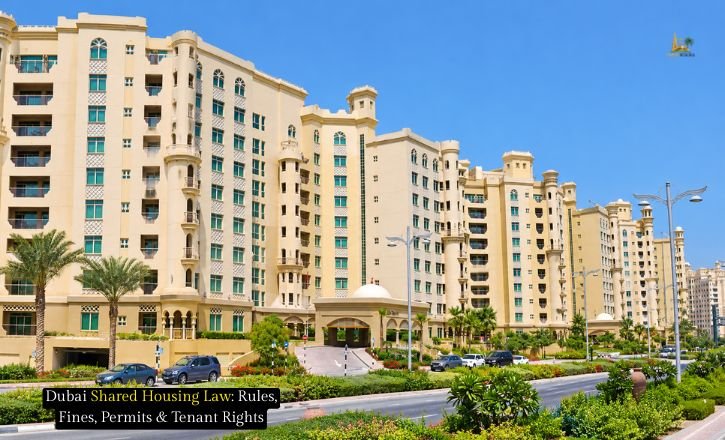
Dubai has enacted certain rules and regulations for shared housing to ensure better living standards, minimize overcrowding, and secure property owner rights and interests. Dubai Law No. 4 of 2026 (the ‘Dubai Shared Housing Law’) was issued by Sheikh Mohammed bin Rashid Al Maktoum on 11 March 2026.Dubai Law No. 4 of 2026 (the ‘Dubai Shared Housing Law’) was issued by His Highness Sheikh Mohammed bin Rashid Al Maktoum on 11 March 2026.
For tenants living in shared rooms, owners who allow tenants to stay in their property, and businesses looking after shared housing in Dubai, the law is a significant consideration. Sets guidelines for permits, property standards, rental policies, and fines for breaches.
Knowing how the Dubai shared housing law is structured can help you prevent non-compliant bed space rentals, apartment rentals, and room rentals.
In this guide you’ll get an overview of the key rules, what permits will be required, what the possible penalties will be and what tenants’ rights will be with respect to the 2026 legislation.
What Is Dubai Shared Housing Law?
The Dubai Law No. 4 of 2026 provides for the regulation of management and occupation of residential property intended for shared use. Generally, shared housing involves a multiple family or person setting where each family or individual has a defined space to live in and shares with others access to kitchens, dining areas, bathrooms, or other outdoor areas.
The purpose of the law is to make housing more safe and secure, safeguard rights of property owners and occupants, decrease overcrowding and eliminate unregulated shared housing.
It covers all properties in Dubai that are relevant to it, including in private development zones and free zones. This also includes authorised property owners, the residents of designated shared housing, and licensed businesses that lease and/or manage such properties. It does not cover units for collective labour accommodation.
What Counts as Shared Accommodation in Dubai?
Shared accommodation may include situations in which the residents have separate accommodation but use shared facilities.
Examples may include:
- A number of people in an apartment complex.
- People who live in apartments with other people in it.
- Any special treatment offered to a company’s staff.
- Students’ lodgings provided by or arranged by an educational institution.
- Housing for multiple residents’ use.
But the term in an advertisement does not decide if an arrangement is legal or not. The use, approval, occupancy and rental rate of the property are relevant.
Which Authorities Regulate Shared Housing in Dubai?
Under the 2026 law, Dubai Municipality will be the primary authority tasked with overseeing shared housing. It establishes related technical and occupancy requirements, in coordination with the Dubai Land Department and other competent authorities.
The Dubai Land Department has roles concerning the regulation of property leasing and management activities, including property engaging in leasing and/or management and contracts related to it. Other authorities may be involved if the property is in a special development zone or free zone.
The right authority varies depending on the problem, for the residents and landlords. A report or application for a shared-housing permit question, building safety complaint or tenancy dispute may necessitate reporting/filing through other channels.
Dubai Shared Housing Rules for Tenants and Landlords
A new law in Dubai will create a formal framework for shared accommodation in 2026. All property owners or licensed operators need the proper permit, technical requirements and guidelines to lease or operate designated shared housing.
Is Sharing an Apartment Legal in Dubai?
Living in an apartment with another person is not a crime. A house that is designed for shared use, though, should meet the guidelines.
Law No. 4 of 2026 stipulates that, without a permit, a property may not be established as a shared housing. The conditions of authorised occupancy, available space, facilities and conditions of the property should comply with the applicable requirements.
When people move into a shared apartment, they should obtain a confirmation from the accommodation that it is approved for its planned purpose. An apartment rental contract is not conclusive proof that the property meets shared housing standards.
Is Renting a Bed Space Legal in Dubai?
Bed space accommodation is frequently marketed to people who wish to reside in accommodation that is not as costly. Any advertisement for a bed space does not mean that it is a legal arrangement.
The new legislation requires shared housing to be run in the authorized rental strategies and meet occupancy and safety standards. The residents need to verify who is permitted to rent the property and if the property has the required approval.
Tenants are also not allowed to be able to lease the property or space that they have to sublet it to another individual. Thus, those who rent their beds from an existing tenant should take extra caution in choosing the type of person who is providing the accommodation.
Can Tenants Sublet a Room Without the Landlord’s Permission?
The 2026 shared housing law introduces certain limitations to subletting designated housing in common areas. It says that any person or authorised property can only lease such property. This does not permit residents or any others to sublet the property or their respective space to another person.
Tenants must not presume that they have the right to rent a room or a bed, just because they are renting the apartment.
Prior to considering subletting it is advisable for parties to evaluate their tenancy agreement and the relevant rules and regulations with the relevant authority. There are also other Dubai rental laws that might apply to ordinary tenancy arrangements.
Are Partitioned Rooms Allowed in Dubai?
Sometimes rooms separated from each other can cause concerns when they affect the intended use of the property, increase the number of occupants beyond the permitted limit, or pose a safety hazard.
All properties in the shared housing law are required to conform to applicable building, health, fire, sanitation, security and electrical standards. It also provides for the competent authorities to set the maximum number of people that can be in a home at any given time and how much space each person is permitted to occupy.
Residents should please not presume that a partitioned room is approved solely because it is available for rent. Owners and operators must check building and accommodation regulations prior to providing or promoting additional sleeping accommodation.
Can Families and Unrelated Individuals Share an Apartment?
Shared housing is differentiated by the law in several categories: families, individual women, individual men, student, employees of government bodies or private organisations. The criteria to be considered for these categories are to be decided within the due course of the relevant regulations.
The suitability of a property for a family or group of unrelated occupants is determined by the permitted use, category, occupancy limit and approval conditions.
Residents should double check the needs of their specific Dubai apartment instead of taking a general rule that works for all apartments in Dubai.
Dubai Shared Housing Permit: Requirements and Approvals
Before allocating a property for shared housing, one of the most important requirements in Dubai Law No. 4 of 2026 is to acquire a permit.
Dubai Municipality is responsible for the control of shared housing, and the competent authority rules on the applications and renewals of permits on a single digital platform. The Dubai Land Department keeps the shared housing registry and manages the information and leasing of such housing.
When Is a Shared Accommodation Permit Required?
No person or legal person may allocate a property for shared housing without a permit in accordance with the law.
This requirement relates to properties that are registered for shared accommodation. It should not be assumed that all individuals living in a common residential tenancy with a flatmate require an individual permit. The question is whether the property and arrangement is included in the regulated shared housing system.
Compliance with the relevant authorisation and licensing requirements is also required for business that lease or manage shared housing.
Documents and Information Needed for a Permit
Specific paperwork and application process will depend on the rules set by the competent authorities. Applicants may have to provide data on:
- The right to property or the legal right to control the property.
- The property address, type and the appropriate building information.
- The number of people that is planned to share the house and the living space available.
- The support and services offered to the residents.
- Technical, building and safety approvals.
- The contract of lease or management that pertains.
These are only a few general preparation points and not a complete list of documents to be confirmed. Applicants are advised to check the official requirements prior to applying.
How Long Is a Shared Housing Permit Valid?
A shared housing permit is valid for 1 year and may be renewed for the same term as the first. Permit may be issued for two years at the discretion of the competent authority upon owner’s request.
Renewal applications should be made a minimum of 30 days prior to the end of the permit.
Property owners should be aware of the expiration date of the permit and ensure they are up to date with the current renewal process by checking with the appropriate authority.
Dubai Shared Housing Fines and Penalties
The shared housing law in Dubai stipulates monetary fines for any infringement on its rules and the rulings made in compliance with the same. The fines vary according to the relevant legislation and nature of the offence.
According to the official announcement, fines can be as high as AED 500,000. The penalties will be doubled for repeated violations within a year, up to a maximum of AED 1 million.
A general range of penalties as per the law.
AED 500–500,000
Repeat offenses in a year will receive double fines up to AED 1 million. The quantity is based on the relevant provisions of the violation and enforcement.
Fines for Illegal Shared Accommodation
Sharing of a property without the proper permit may be illegal.
Before a property is used for shared accommodation, the property owner/operator must ensure that the property is authorised to be used for shared accommodation. A rental advertisement or an “informal” agreement with residents is not considered to be the permit.
The general guideline range should not be viewed as a set penalty for each and every unpermitted property. The consequences of the violation will depend on the specific violation and the applicable enforcement provisions.
Penalties for Overcrowding
Dubai Municipality sets the requirements in relation to maximum occupancy, space per person and shared facilities.
If a property is over-occupied or doesn’t comply with relevant housing regulations, it could be targeted for enforcement measures. A general occupancy number is not appropriate as capacity is dependent on property and the requirements associated with it.
Fines for Unauthorised Subletting
The law regulates the type of tenants that can be permitted in designated shared housing and doesn’t allow the tenants allocated a space to rent it to someone else.
If a tenant is considering renting out a room or bed space, it is important that they determine if that is allowed. Property owners should also ensure that any establishment they have appointed to manage or lease their property is authorized.
The possible consequences vary depending on the specific misbehaviour and the relevant legislation.
Penalties for Unauthorised Partitions
Non-compliant partitions or those which are deemed to pose a safety risk to the residents may result in enforcement action pursuant to the relevant legislation.
Technical and safety standards have to be complied with per the shared housing law. Corrective measures and/or other permitted enforcement action may be required depending upon the circumstances.
Can Both Landlords and Tenants Be Penalised?
The law provides responsibilities for owners, licensed premises and residents. The party responsible is determined by the actions committed and the obligations/duties under the provisions.
Fines are also recorded in the official announcement, alongside potential administrative action which could involve suspension of the activity for up to 6 months, cancellation of the permit, revocation of a commercial licence, disconnection of public services until the violation is rectified and the eviction of units that do not meet the permit requirements.
These are not measures that are taken in all situations. The result is dependent on the violation and enforcement decision that is applicable.
Dubai Shared Housing Law: Tenant Rights
The law aims to safeguard the rights of both property owners and residents. It sets the rules for rental agreements, rights to be present in the property and obligations of the users of shared housing.
Homeowners need to be aware of their contractual rights and retain copies of the documents that impact their home.
Right to Clear Rental Terms
The law provides for lease contracts containing key information about the landlord, property, number of occupants, and spaces allocated to residents. In the Dubai Land Department, the relevant contract information is determined and standardised templates are provided.
Before signing an agreement, residents should do checks on the rent, rent schedule, deposit, utilities, common facilities and the duration of the rent. They should also validate which area they have the right to be.
A written contract lets both parties know what they are responsible for, and serves as proof should a problem occur.
Protection Against Unlawful Eviction
Residents should not assume that a landlord can evict them without going through the appropriate legal procedures.
Rights and remedies may vary based on the rental agreement, contract, and applicable tenancy laws. When a landlord has demanded a resident leave their apartment or condo prematurely, the resident should keep the rent agreement and payment record and consult with the relevant authority for advice.
In the case of disputes related to rights and obligations arising under the shared housing law, the official announcement specifies the jurisdiction of the Dubai Rental Disputes Centre in resolving and hearing such disputes.
Also Check: Al Manara Tower Dubai
Security Deposits and Refunds
Not all deposit disputes end in the same way in the shared housing law. The terms of deposit and any relevant tenancy regulations are still relevant.
It is a good idea for residents to get in writing confirmation of the amount of the deposit, to retain receipts, and to record the condition of the accommodation on moving in and out. The deductions should be checked in accordance with the terms of the rental agreement and the law.
Residents can seek advice on what dispute-resolution procedure to follow if there is a disagreement that cannot be resolved directly.
Privacy and Access to the Rented Space
Residents need to be aware of what areas they have and what shared facilities they do not have.
The rental agreement must be clear about the rented space, and how common areas are available for use. Residents should also make clear details about how shared area aspects are to be maintained, accessed, cleaned and used.
Should there be any dispute as to access or use of the rented area, the contract and available law will assist in deciding what access and use rights and obligations exist.
What Can Tenants Do If a Landlord Breaks the Agreement?
Residents should record the issue if a landlord or accommodation operator does not fulfil the agreed obligations and retain evidence of this.
One first step they can take is to address it in writing and ask for clarification or a resolution. Should the problem be one with regard to unsafe conditions, unauthorised accommodation or contractual dispute, the next step is to contact the competent authority or obtain expert legal counsel.
It is important to note that complaints can apply to the shared-housing regulatory or to a rental dispute and the process might be different.
Responsibilities of Landlords and Property Owners
The role of property owners in ensuring that designated shared accommodation follows the rules laid down in Dubai is key.
Requirements on authorised owners and establishments include permits, property standards, occupancy, contracts and managing residents.
Complying With Occupancy and Safety Requirements
Owners are responsible for ensuring that shared housing that is designated complies with the relevant technical standards. These include such building standards, occupancy limits, space allocations and the shared facilities that are required.
Fire safety, health, sanitation, security and electrical considerations are also covered by the law. To ensure safe sharing of space, owners should check the standards that may be applicable to their specific property.
Obtaining Required Consent and Approvals
No property can be approved for shared housing without the necessary permit.
Owners should check the conditions of approval and verify the appropriate business is appointed to manage or lease the property and has the necessary authorisation. They should also make sure that the rentals go in line with the house use.
Providing Clear Rental Agreements
Rental records should provide party identification and information about the property, space, and number of residents.
The agreement should accurately represent the authorised accommodation arrangement and be presented with necessary information to residents by the owner/operator.
Avoiding Unauthorised Room Divisions or Commercial Use
Owners should not presume that a property can be used for shared accommodation just by adding partitions or by letting out extra beds.
Any alterations to the usage and layout of the property should meet the requirements. Unauthorised arrangements could be a safety risk and subject responsible parties to enforcement.
How to Report Illegal Shared Accommodation in Dubai
Civil citizens can contact the competent authority responsible for the property and the type of violation if they suspect there is an overcrowding problem, unsafe housing or if it is not registered as shared housing.
The law of 2026 stipulates that complaints may be made to competent authorities regarding owners, establishments, residents and persons who allocate and lease properties for shared housing without a permit. They have the ability to do this with a process of investigation and take suitable action.
Also Visit: Latifa Tower Dubai
Which Authority Should You Contact?
Dubai Municipality is the primary authority in charge of shared housing. Relevant shared housing registry and leasing and/or management is handled by Dubai Land Department.
If it is a problem in a special development zone or free zone, the authority responsible for the area may also be involved. Disputes regarding rentals shall go to the proper dispute-resolution forum.
Official resources:
- Dubai Legislation Portal — consult the published legislation.
- Dubai Government’s announcement of Law No. 4 of 2026 — review the law’s key provisions and enforcement measures.
Information to Prepare Before Making a Complaint
Initiate the property location, description of suspected violation and rental documents and other lawfully obtained evidence.
Give the dates and type of the problem if possible. Do not trespass in private property or risk to gather evidence.
The competent authority will benefit from clear information to understand the complaint and what action it should take next.
What Happens After a Complaint?
The competent authority is entitled to consult the information, investigate the case and find out whether the property or the parties to the case have been in breach of the requirements that apply to the case.
The action taken is determined by the evidence, and by the nature of the violations. Some measures are possible, but not necessarily assumed, and are subject to the applicable law.
How to Find Legal Shared Accommodation in Dubai
There is more to consider when looking for affordable housing than the monthly rent. Homeowners should also check that the home and rental complies with the relevant regulations.
Check the Rental Agreement and Landlord’s Authority
Inquire with the person providing the accommodation and whether they have the proper legal authority to provide it or to supervise the shared-housing situation.
You should read the terms of the contract before paying it off. Ensure that it specifies the location of your assigned space, rent, deposit, facilities and other key terms.
Confirm Occupancy and Building Requirements
Inquire if the property is allowed to accommodate the amount of people proposed to stay and if the room setup is in accordance with the regulations.
Avoid accepting an ad or word of mouth only. Ask for information and check when necessary.
Avoid Unsafe or Unclear Rental Arrangements
If a provider does not provide a written agreement, cannot describe their right to provide the space or provides housing that looks overcrowded or unsafe, proceed with care.
Save rental receipts and copies of all rentals. Ensure that utilities and shared facilities are dealt with prior to signing a lease agreement.
The following measures can aid residents and minimize the potential for conflict.
When Does Dubai Shared Housing Law Take Effect?
Law No. 4 of 2026 was issued on 11 March 2026. According to official announcement it will come into force after 180 days from its publication in the Official Gazette. It also allows a period of one year for the existing shared-housing properties and businesses to adjust their practices according to the guidelines provided, which can be extended once by the Director-General of Dubai Municipality.
The date of the commencement is subject to publication in the Official Gazette, therefore, the reader must see the official legislation record for the exact date and any subsequent implementing decisions.
The transition period does not mean an exemption from any and all safety, building, tenancy or other legal requirements.
Conclusion
The Dubai Law No. 4 of 2026 provides a structure for shared housing, with a permit, criteria for living in shared housing, rental agreements, safety measures and fines for non-compliance.
The most important procedures for tenants are verification of the accommodation, understanding the rental agreement and confirming the authority of the person providing the space. Property owners/operators need to be aware of the necessary permits and standards to comply with and the rules for the management and leasing of shared property.
Be sure to consult the competent Dubai authority regarding these requirements before you rent or offer shared housing. This is particularly important during the process of confirmation of commencement of the law, transition arrangements and implementing procedures.
The information contained in this article is not intended to be legal advice. Applicability requirements should be read in conjunction with the legislation and the relevant authorities and are specific to a reader’s situation.
FAQs About Dubai Shared Housing Law
Is shared accommodation legal in Dubai?
Shared housing may be legal as long as the requirements are met. Law No. 4 of 2026 contains regulations on shared housing which will only be valid when a permit is obtained and the property complies with occupancy, technical and safety requirements.
Is bed space legal in Dubai?
A bed space is not necessarily legal just because it’s being advertised for rent. Residents should check the approval status of the property; and the provider’s right to occupy the property, and the rules applicable to shared housing.
How many people can legally live in one apartment in Dubai?
No single occupancy number should be assumed for all apartments. The maximum number of occupants and minimum space per person is determined by Dubai Municipality based on the related regulations and property condition.
What is the fine for illegal shared accommodation in Dubai?
The general fine range under Law No. 4 of 2026 is AED 500 to AED 500,000. The fine may be doubled if the violations are repeated in the course of a year, up to maximum of AED 1 million. Penalty varies with the violation and enforcement provisions.
Do tenants need a permit to share an apartment in Dubai?
The law calls for a permit for a shared housing property. However, this does not imply that all conventional flat-share situations imply that each tenant must have an independent permit. Use of the property and particular arrangements should be checked.
Can I rent out a room in my Dubai apartment?
Do not expect to sublet a room or bed space without any restrictions. Occupants are not allowed to sublet their allocated spaces and the leasing of the designated shared housing may only be done by the owner or an authorised establishment as per the shared housing law. Be sure to read the rules before playing.
Can a landlord evict tenants for unauthorised subletting?
The legal implications of unauthorised subletting vary and largely depend on the situation, the law and the necessary steps. If there is a dispute between a resident and a landlord, they should seek advice from the proper authority.
Where can I report overcrowded accommodation in Dubai?
Begin with Dubai Municipality or the competent authority of the location of the property. For matters related to the registry, rental, leasing or management of a property, or rental disputes, Dubai Land Department and Dubai Rental Disputes Centre may be of relevance.
