
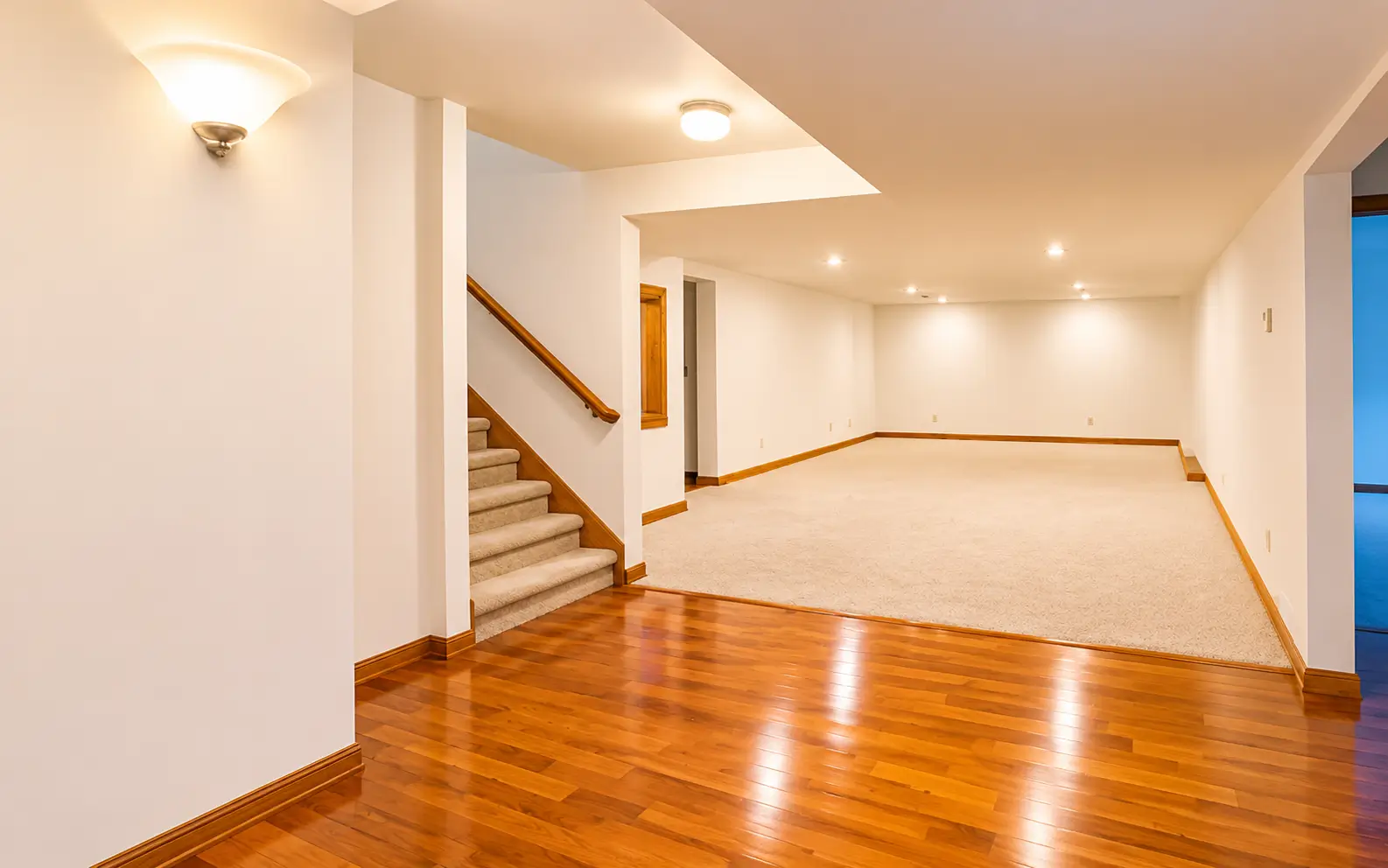
The best basement flooring options are waterproof, sit well on concrete and cope with damp air. For most homes, rigid-core luxury vinyl plank (SPC) is the best all-round pick. Porcelain tile, epoxy and polished concrete are the toughest choices for a basement that floods. Sealed or stained concrete is the cheapest floor, because you already own it.
Basements are hard on floors. The slab sits below ground, pulls moisture from the soil and stays cool all year. A floor that works upstairs can cup, peel or grow mold down here.
Quick answer
- Best overall: SPC Flooring
- Best for flooding: porcelain tile, epoxy or polished concrete
- Cheapest: sealed, stained or painted concrete
- Most comfortable: carpet tiles or carpet over a dry subfloor
- Best for a home gym: rubber flooring
Prices in this guide are approximate installed costs per square foot in UAE dirhams (AED), converted from U.S. national averages at 1 USD = 3.6725 AED. Local quotes vary by supplier and installer.
Best Basement Flooring by Situation
Start with your basement’s conditions, not just the look you want. Moisture and humidity matter most when choosing the right flooring. LVT flooring in Dubai is a popular choice for homeowners looking for stylish, durable luxury vinyl flooring with realistic wood and stone designs. For basements, LVT and rigid-core SPC options can both offer practical flooring solutions, depending on the product’s construction and moisture requirements.
| Your basement | Best pick | Runner-up | Avoid |
| Dry, finished living space | SPC luxury vinyl plank | Carpet tiles | Solid hardwood |
| Bare concrete, tight budget | Sealed or stained concrete | Sheet vinyl | Glue-down carpet |
| Damp or humid | SPC luxury vinyl plank | Porcelain tile | Standard laminate |
| Floods now and then | Porcelain tile or epoxy | Interlocking PVC tiles | Wall-to-wall carpet |
| Uneven slab | Rigid SPC vinyl after leveling low spots | Subfloor panels with carpet | Sheet vinyl, large tile |
| Home gym | Rubber flooring | Interlocking tiles | Laminate |
| Bathroom or laundry | Porcelain tile | Sheet vinyl | Carpet, laminate |
Why Basement Floors Need Special Care
A basement floor faces moisture from below, not just spills from above. Concrete is porous. Even a slab that looks dry pushes water vapor up from the soil. Flooring pros call this vapor drive.
Three other things make basements tough:
- Cold slabs. Warm, humid air hits the cool concrete and forms condensation under rugs and floating floors.
- High humidity. Summer air below grade often runs damp, which feeds mold and swells wood fibers.
- Flood risk. Heavy rain, a failed sump pump or a burst pipe can put standing water on the floor.
The rule is simple. Inorganic and plastic-based materials (tile, concrete, vinyl, rubber) handle basements well. Wood, wood fiber and natural fibers carry more risk.
Test Your Basement Slab for Moisture First
Test before you buy. A waterproof floor laid over a wet slab can still trap moisture, smell musty and void its warranty.
- Plastic sheet test (ASTM D4263). Tape an 18-by-18-inch sheet of clear plastic to the slab on all four sides. Wait at least 16 hours, ideally a full day. Drops under the sheet mean moisture is rising through the slab. Drops on top mean humid air is condensing on the cold floor.
- Calcium chloride test (ASTM F1869). A kit measures how many pounds of moisture the slab gives off per 1,000 square feet in 24 hours. Compare the number with your flooring maker’s limit.
- Relative humidity probe test (ASTM F2170). A pro drills small holes into the slab and reads the humidity inside it. This is the most accurate test, and many flooring makers now ask for it.
Every product lists its own moisture limit. Check that limit and keep your test results with your receipt in case you ever need to file a warranty claim.
Fix Water Problems Before You Install
No floor fixes a leak. Look for white chalky deposits (efflorescence), water marks, a musty smell or puddles after rain. Then fix the source:
- Clean gutters and extend downspouts well away from the house.
- Make sure the soil slopes away from the foundation.
- Seal cracks in the slab and walls.
- Add an interior drain and sump pump if water keeps coming in.
- Run a dehumidifier to hold indoor humidity between 30% and 50%.
For a damp basement, budget about AED 18 to 37 per square foot for waterproofing before any finish work begins.
12 Best Basement Flooring Options
Each option below lists what it is best for, its pros and cons, its 2026 cost, how it installs and how long it lasts. Lifespans are typical ranges for a home with normal care.
1. Luxury Vinyl Plank and Tile (SPC)
Best for: finished basements, family rooms, damp basements
Luxury vinyl plank (LVP) and luxury vinyl tile (LVT) are the most popular vinyl flooring options for basements today. Pick a rigid SPC (stone plastic composite) core. It blends limestone and PVC, so it will not swell, rot or feed mold. WPC (wood plastic composite) feels softer and warmer, but it moves more when basement temperatures swing.
Pros
- The planks are fully waterproof.
- It looks like real wood or stone.
- It floats over concrete with click-lock joints, so it suits DIY.
- The rigid core bridges small dips in the slab.
- After a minor leak, you can often lift the planks, dry them and reinstall them.
Cons
- The seams are not watertight under standing water.
- Water trapped under the planks can grow mold if you leave it.
- Cheap, thin planks dent and scratch.
- It can fade in direct sun in a walkout basement.
Cost: AED 15 to 59 per square foot installed · DIY level: easy to moderate · Lifespan: 15 to 25 years
Pro tip: Choose a wear layer of at least 12 mil for light use and 20 mil or more for kids, pets or a gym. Use the vapor barrier the maker specifies.
2. Sheet Vinyl and Peel-and-Stick Tiles
Best for: laundry rooms, bathrooms, tight budgets
Sheet vinyl rolls out in one large piece, so it has far fewer seams than plank or tile floors. That makes it great for wet zones. Peel-and-stick vinyl tiles are the cheapest DIY floor you can buy.
Pros
- It has few or no seams, so water stays on top.
- It is low cost and quick to install.
- It is soft and quiet underfoot compared with tile.
Cons
- It is thin and shows every bump, crack and pebble in the slab.
- Sharp objects can tear it.
- Adhesive can fail on a damp slab, and peel-and-stick tiles often lift.
- It adds little resale value.
Cost: AED 7 to 26 per square foot installed · DIY level: easy (peel-and-stick) to moderate (sheet) · Lifespan: 10 to 20 years
3. Waterproof Laminate
Best for: dry finished basements where you want a hard, wood-look surface
Laminate has a wood-fiber core under a photo layer and a tough clear top. Standard laminate does not belong in a basement. Newer waterproof laminate seals the core and joints, so spills can sit on top for hours without harm.
Pros
- It has one of the most scratch-resistant surfaces you can buy.
- The wood look is very realistic.
- It costs less than engineered hardwood.
- Click-lock planks make it a fair DIY job.
Cons
- The core is still wood fiber. Water from below, or water left standing, can swell it.
- It is not a good choice for a flood-prone basement.
- It needs a vapor barrier underlayment over concrete.
- You cannot refinish it.
Cost: AED 15 to 51 per square foot installed · DIY level: moderate · Lifespan: 15 to 25 years
Watch out: “Waterproof” laminate ratings cover spills on top. They do not cover moisture rising through the slab.
4. Porcelain and Ceramic Tile
Best for: basement bathrooms, laundry rooms, wet bars, flood-prone basements
Porcelain and ceramic are the two main tile basement flooring options, and both work well below grade. Porcelain is denser than ceramic and absorbs almost no water. Both can go straight onto a clean, flat slab.
Pros
- The tile survives flooding. You dry it, clean it and move on.
- It lasts for decades.
- It works well with radiant floor heat.
It comes in wood, stone and concrete looks.
Cons
- It feels hard and cold.
- Grout needs sealing and can stain.
- Labor makes it one of the pricier options.
- Tile can crack if the slab moves. An uncoupling membrane helps.
Cost: ceramic AED 44 to 147, porcelain AED 55 to 184 per square foot installed · DIY level: hard · Lifespan: 50 years or more
5. Epoxy Flooring
Best for: laundry rooms, workshops, gyms, flood-prone basements
Epoxy basement flooring is a two-part resin coating that bonds to the concrete. It can be a solid color or carry decorative flakes or a metallic swirl. Polyaspartic coatings work the same way and cure faster.
Pros
- It is seamless and waterproof on top.
- It is easy to mop and resists stains and chemicals.
- It brightens a dark basement.
- It lasts well under heavy use.
Cons
- It needs a dry slab. Rising vapor can push the coating loose.
- Prep means grinding and repairing the concrete.
- It can be slippery when wet unless you add grit.
- It feels hard and cold, and it smells strong during install.
Cost: AED 15 to 37 per square foot by a pro, or about AED 7 to 18 for DIY · DIY level: moderate · Lifespan: 10 to 20 years
6. Polished Concrete
Best for: modern living spaces, studios, flood-prone basements
A pro grinds the slab with diamond pads, hardens it and polishes it to a matte or glossy shine. Nothing sits on top, so nothing can peel, rot or float away.
Pros
- After a flood, you only have to dry and clean it.
- It needs very little upkeep.
- It resists mold and holds no odors.
- It pairs well with radiant heat and area rugs.
Cons
- It is hard, cold and can echo.
- It shows old cracks and patches.
- It needs pro equipment and creates dust.
Cost: AED 11 to 29 per square foot for basic to mid-range polishing; decorative finishes can reach AED 55 or more · DIY level: pro only · Lifespan: as long as the slab, with a fresh polish every few years
7. Stained, Painted or Sealed Concrete
Best for: utility rooms, storage areas, tight budgets
This is the cheapest way to finish a basement floor over concrete. Acid stain reacts with the concrete and leaves a permanent, marbled color with no film to peel. A clear sealer protects the surface. Paint also works, but only a product made for concrete floors, such as a one-part epoxy paint.
Pros
- It costs the least of any option.
- It is a one-weekend DIY project.
- Water does little harm to a stained and sealed slab.
- Area rugs add warmth where you need it.
Cons
- Regular paint blisters and peels when vapor rises through the slab.
- Sealers and paint need a fresh coat every few years.
- It hides nothing. Cracks and stains stay visible.
- It feels cold underfoot.
Cost: sealing AED 3 to 6, painting AED 5.5 to 11, staining AED 7 to 37 per square foot · DIY level: easy · Lifespan: stain lasts decades; sealer and paint last 2 to 5 years
8. Rubber Flooring
Best for: basement gyms, playrooms, workshops
Rubber is the top basement gym flooring option. It comes in rolls, interlocking tiles and heavy mats, often made from recycled tires.
Pros
- It absorbs shock and protects the slab from dropped weights.
- It deadens noise.
- It grips well, even when damp.
- It resists water and mold.
Cons
- New rubber can smell for weeks.
- It looks like a gym floor, not a living room.
- Water can seep through the seams of tiles and rolls.
- Thick rubber is heavy to move.
Cost: AED 15 to 62 per square foot installed; material alone averages AED 11 to 29 · DIY level: easy (tiles) to moderate (rolls) · Lifespan: 20 years or more
Pro tip: Use about 3/8 inch for cardio and bodyweight work. Go to 3/4 inch where you drop heavy free weights.
9. Carpet Tiles
Best for: playrooms, family rooms, basements with an occasional small leak
Carpet tiles are square pieces of carpet with a plastic backing. You lay them like a puzzle, with or without small sticky tabs.
Pros
- They are soft, warm and quiet.
- They are an easy DIY job with no special tools.
- You can swap out one stained tile instead of the whole floor.
- After a leak, you can lift them, dry them and put them back.
Cons
- They are still fabric and hold moisture if they stay wet.
- The seams can show.
- They are not a fit for a basement that floods often.
Cost: AED 7 to 40 per square foot installed · DIY level: easy · Lifespan: 10 to 15 years
Pro tip: Choose synthetic fibers such as nylon, polyester or olefin. Skip natural fibers and jute backings below grade.
10. Wall-to-Wall Carpet Over a Subfloor
Best for: dry basement bedrooms, home theaters, cozy family rooms
Carpet is the warmest and quietest choice for a finished basement. It only works in a basement that stays dry. Lay it over subfloor panels or a vapor barrier with a moisture-resistant pad. Never glue it straight to the slab.
Pros
- It is the most comfortable floor for sitting and playing.
- It absorbs sound, which helps in a home theater.
- It adds warmth over a cold slab.
Cons
- It soaks up water and can grow mold.
- After a flood, you usually have to tear it out.
- It traps dust and allergens.
Cost: AED 7 to 29 per square foot installed, plus subfloor panels if needed · DIY level: pro recommended · Lifespan: 8 to 15 years
11. Engineered Hardwood
Best for: dry, climate-controlled basements where you want real wood
Engineered hardwood has a real wood top layer glued over a plywood or fiberboard core. The layered build makes it far more stable than solid wood, which should not go below grade at all.
Pros
- It gives you the look and feel of real wood.
- It can add resale appeal.
- A thick top layer can be sanded and refinished once or twice.
Cons
- It is not waterproof and can swell, cup or warp.
- It needs a dry slab, a vapor barrier and steady humidity.
- It costs more than most options.
- It scratches like any wood floor.
Cost: AED 26 to 73 per square foot installed · DIY level: moderate · Lifespan: 20 to 30 years or more
Watch out: Buy only products the maker approves for below-grade use, and follow its install rules exactly to keep the warranty.
12. Interlocking PVC and Foam Tiles
Best for: flood-prone basements, playrooms, gyms, quick DIY jobs
This is one of the most overlooked basement flooring ideas. Rigid PVC tiles snap together and float over the slab. Some have a raised base with channels, so air moves and water drains underneath. Soft EVA foam tiles make a cheap, cushioned floor for a kids’ play area.
Pros
- They need no glue and go down in a few hours.
- You can lift, dry and reuse them after a flood.
- A raised base keeps the top surface off a damp slab.
- They hide small cracks and stains.
Cons
- The seams show, and some styles look utilitarian.
- Foam tiles dent and wear out fast.
- Some rigid tiles sound hollow underfoot.
Cost: about AED 4 to 18 per square foot for many PVC and foam tiles; raised tiles with vinyl tops cost more · DIY level: easy · Lifespan: foam 3 to 5 years; rigid PVC 10 to 20 years.
Basement Flooring Comparison Table
This table puts all 12 basement flooring options side by side. “Waterproof” means the material itself survives standing water. “Resistant” means it handles spills and damp air but not a flood.
| Flooring | Installed cost (AED per sq ft) | Water rating | Comfort | DIY level | Lifespan (years) | Best for |
| SPC luxury vinyl plank | AED 15–59 | Waterproof | Medium | Easy–moderate | 15–25 | Finished living space |
| Sheet vinyl / peel-and-stick | AED 7–26 | Waterproof (sheet) | Medium | Easy–moderate | 10–20 | Laundry, bathroom, budget |
| Waterproof laminate | AED 15–51 | Resistant | Medium | Moderate | 15–25 | Dry family room |
| Porcelain / ceramic tile | AED 44–184 | Waterproof | Low | Hard | 50+ | Bathroom, flood-prone |
| Epoxy coating | AED 15–37 (DIY AED 7–18) | Waterproof | Low | Moderate | 10–20 | Laundry, workshop, gym |
| Polished concrete | AED 11–29 | Waterproof | Low | Pro only | Life of slab | Modern living, flood-prone |
| Stained / painted / sealed concrete | AED 3–37 | Waterproof (stain) | Low | Easy | Stain: decades; coatings: 2–5 | Utility, storage, budget |
| Rubber | AED 15–62 | Waterproof material | High | Easy–moderate | 20+ | Home gym |
| Carpet tiles | AED 7–40 | Resistant | High | Easy | 10–15 | Playroom, family room |
| Wall-to-wall carpet | AED 7–29 + subfloor | Poor | Highest | Pro | 8–15 | Dry bedroom, theater |
| Engineered hardwood | AED 26–73 | Poor | Medium | Moderate | 20–30+ | Dry, upscale space |
| Interlocking PVC / foam tiles | AED 4–18 | Waterproof material | Medium–high | Easy | 3–20 | Flood-prone, playroom |
Prices are in AED per square foot, installed. Lifespans are typical ranges and depend on traffic, moisture and care.
Best Basement Flooring Options Over Concrete
You have four ways to put a floor over a concrete slab. Pick the one that matches your slab’s condition.
- Finish the slab itself. Polish, stain, seal or coat it with epoxy. This is the best choice when the slab is sound and you want zero risk of trapped moisture.
- Bond directly to the slab. Tile, sheet vinyl and peel-and-stick tiles stick to the concrete. The slab must be clean, flat and dry.
- Float over the slab. LVP, laminate, engineered wood and carpet tiles sit loose on an underlayment or vapor barrier. Floating floors forgive small flaws and come up easily.
- Build a raised subfloor. Subfloor panels with a dimpled plastic base lift the floor off the slab and let air move underneath. This is the safest base for carpet and engineered wood.
Before any of these, clean the slab, fill cracks, check that it is flat, and run a moisture test. Then follow the maker’s rules for the vapor barrier. Some products need one, some have one built in, and some forbid adding a second layer.
Waterproof and Wet Basement Flooring Options
For a damp or wet basement, choose a floor that is waterproof all the way through, not just on top.
| Rating | Flooring options |
| Waterproof material | Porcelain and ceramic tile, epoxy, polished or stained concrete, SPC vinyl, sheet vinyl, rubber, rigid PVC tiles |
| Water-resistant | Waterproof laminate, WPC vinyl, carpet tiles |
| Not for wet basements | Wall-to-wall carpet, engineered hardwood, solid hardwood, cork, standard laminate |
A waterproof floor still needs a dry slab underneath. If water seeps through the concrete, it collects under the floor, where you cannot see it. Fix leaks first, then run a dehumidifier all year.
Best Flooring for a Basement That Floods
If your basement floods, plan for the next flood now. Use one of three approaches.
- Choose a floor that can get wet. Porcelain tile, epoxy and polished or stained concrete survive standing water. After a flood, pump or squeegee out the water, dry the room with fans and a dehumidifier, then clean and disinfect.
- Choose a floor you can lift. Interlocking PVC tiles, rubber tiles, carpet tiles and some click-lock SPC planks come up by hand. Pull them up, dry both the tiles and the slab, then put them back. Check your warranty first, because some makers limit reinstalling.
- Raise the floor off the slab. Raised plastic tiles and subfloor panels create a small air gap. Minor water can pass underneath without soaking the surface.
Avoid wall-to-wall carpet, laminate, engineered wood and cork in a basement that floods. They soak up water and usually end up in the dumpster. If sewage backs up, throw out any porous flooring it touches and disinfect hard floors.
Also protect the room itself. A sump pump with a battery backup and a backwater valve on the main drain can stop many floods before they start.
Basement Flooring Options for Uneven Floors
Most basement slabs will have dips, humps and old cracks. Always check yours before you buy.
Lay a 6 to 10 foot straight edge or level across the floor in a number of directions and measure the gaps underneath it. Many floating floors will be acceptable with the slab flat within about 3/16″ over 10 feet, although you’ll of course always need to check the spec of your particular product.
How to fix an uneven slab
- Grind the high spots with a concrete grinder.
- Fill the low spots with floor patch or self levelling compound.
- Install the subfloor panels that you can shim level over the wavy slab.
Best floors for uneven basements
- Rigid SPC vinyl plank will bridge the small dips better than thin vinyl.
- Carpet or carpet tiles over a pad will conceal minor bumps.
- Epoxy over the resurfaced slab gives you a smooth new surface.
- Interlocking tiles float over small flaws.
Don’t use sheet vinyl, peel and stick tiles or large format tile on an uneven slab. Thin vinyl will show every single imperfection and large format will either crack or end up sitting at different heights.
Cheap and Inexpensive Basement Flooring Ideas
The cheapest basement flooring options are going to be the concrete you already have. Here they are, ranked from lowest to highest typical cost:
- Sealed concrete. Clean the slab and roll on a clear sealer. It’s the cheapest finish of all.
- Painted concrete. Use a floor paint specifically made for concrete and only on a dry slab.
- Foam or PVC interlocking tiles. Very cheap and they go down in an afternoon.
- Sheet vinyl and peel and stick tiles. That gives you by far the most finished look for the money.
- DIY epoxy kit. It’s tougher than paint if you prep the slab properly.
- Carpet tiles. That’s the cheapest way to get a soft floor.
- Stained concrete. It’s a bit more expensive but the colour will last for decades.
The best value over the long term is probably mid-range SPC vinyl plank. It’s more expensive to buy initially than either paint or sheet vinyl, but it will survive the moisture and the traffic that will eventually destroy the cheaper floors in a few years.
Ways to save on basement flooring
- Do the demolition, cleaning and crack filling yourself.
- Use rugs over the sealed concrete rather than sealing the whole floor.
- Mix the floors by zone e.g. tile in the laundry area and carpet tiles in the play area.
- Buy closeout or overstock flooring (but make sure it’s rated for below grade use).
- Get at least three quotes from installers and ask each of them to price the slab prep as a separate line item.
Best Flooring by Basement Room
The right floor will of course depend on how you’re going to use each of the basement areas.
Basement Gym Flooring Options
Rubber is the way to go. Use interlocking rubber tiles or rubber rolls and go thick in the areas where you’re dropping the heavy weights (see option 8 above). Horse stall mats are a very cheap DIY option. Epoxy will work under a lifting platform but you’ll need to add mats in the areas where the weights actually land.
Basement Bathroom Flooring Options
Porcelain tile is the way to go. Use a slip resistant tile rated for wet areas and go with small tiles in the shower as the grout lines will provide extra grip. Sheet vinyl and SPC vinyl are fine as lower cost alternatives. Don’t use any carpet or laminate in a basement bathroom.
Basement Laundry Room
Choose sheet vinyl, epoxy or tile. All three will cope with washer leaks. Keep the floor drain open and slope the floor to it if you can.
Home Theater and Finished Family Room
SPC vinyl plank with a large area rug gives you a waterproof floor that still has that cosy feel. In a dry basement, carpet over a subfloor is the best sound control you can get for a theatre.
Kids’ Playroom
Carpet tiles and foam tiles are soft for falls and easy to replace when they get stained. SPC vinyl with a play rug is the more durable option.
Workshop and Storage Areas
Epoxy or sealed concrete handles tools, spills and heavy shelves with no bother at all.
Subfloors, Underlayment and Vapor Barriers Explained
What’s underneath the floor is just as important as the floor itself. These are the four layers you’ll hear about.
- Vapor barrier (a sheet of plastic, usually 6 mil polyethylene) to stop moisture from rising up out of the slab. Overlap the seams, tape them and run the edges a few inches up the walls.
- Underlayment (a thin layer of foam, cork or rubber underneath a floating floor) provides cushioning and noise reduction and some types will have a vapour barrier. Many of the SPC planks will have a pad already attached so you wouldn’t normally add a second pad unless the manufacturer specifically allows you to.
- Subfloor panels (interlocking panels with a dimpled plastic base and a wood top) lift the floor off the slab, allow air to get underneath and add a bit of warmth. They also raise the floor level so you need to check door clearances and stair heights.
- Sleeper subfloor (a frame of treated 2x4s with a layer of plywood on top). Used by builders to level an extremely uneven slab or to add insulation. More expensive and takes up more headroom.
Installation and Maintenance Tips
A careful installation will go a long way to helping any basement floor last longer. Follow these steps:
- Acclimatise the flooring. Leave the boxes in the basement for a minimum of 48 hours (or as long as the manufacturer says).
- Buy extra. Order approximately 10% more than you’ve measured and ensure that every box is the same batch/dye lot number.
- Leave expansion gaps. Floating floors will need a small gap at the walls (usually about 1/4″) which will be hidden beneath the baseboard.
- Control the humidity. Run a dehumidifier to keep the humidity between 30% and 50% throughout the year.
- Clean properly. Use a ph neutral cleaner. Don’t use steam mops on vinyl and laminate and do regular resealing of grout and concrete.
- Check the air quality. Look for Floorscore certified or low-VOC products as basements tend to have very little fresh air.
- Test for radon. Test prior to you finishing the space. The EPA recommend remediation if levels are at or above 4 pCi/L and it’s easier to mitigate prior to the floor going down.
- Keep access open at all times. Don’t cover the floor drain, sump pit or cleanouts.
Common Basement Flooring Mistakes to Avoid
- Skipping the moisture test.
- Putting solid hardwood or standard laminate down below grade.
- Painting a damp slab with regular paint.
- Gluing the carpet directly to the concrete.
- Ignoring the dips and the humps in the slab.
- Stacking two underlayments under a plank with an attached pad.
- Leaving no expansion gap at the walls.
- Ignoring the makers below grade rules (which will void the warranty).
Final Recommendation
Start with the moisture, not the looks. Test your slab, sort out any water issues and keep the humidity under control. Then match the floor to your basement:
- Most basements: SPC luxury vinyl plank
- Flood-prone basements: porcelain tile, epoxy or polished concrete
- Tight budgets: sealed, stained or painted concrete with rugs
- Home gyms: rubber flooring
- Bathrooms and laundry rooms: porcelain tile or sheet vinyl
- Cozy, dry living spaces: carpet tiles or carpet over a subfloor
Pick the right floor and get the slab properly prepared and your basement will be a real part of the house for years.
Read Also: Fujairah Bus Station
Disclaimer: This content is for informational purposes only. Details may change over time. Readers should verify information with official sources before making any decisions
