

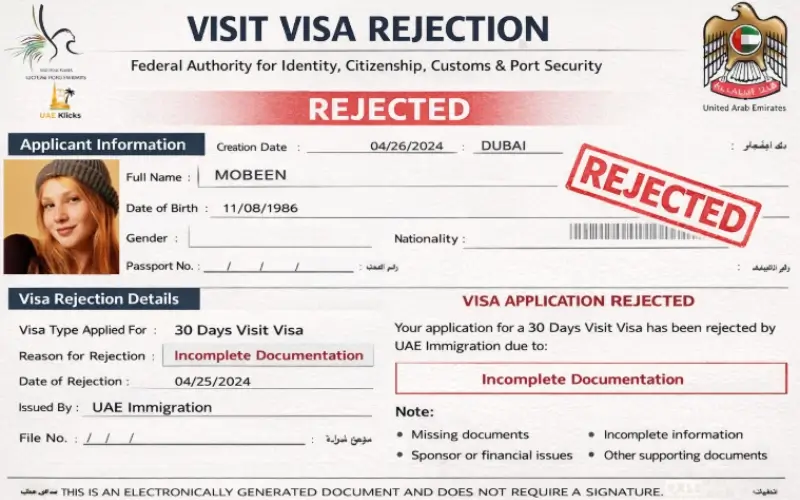
Being denied a visa to visit within the Dubai circumstance can become frustrating or even difficult, particularly when bookings, travel plans or family trips are at stake. Most applicants don’t realize that UAE visit visa refusals are commonplace and often result from specific eligibility, documentation or immigration history concerns instead of random decisions. Knowing the true reasons for rejection is the initial and most crucial step to an effective reapplication.
Dubai adheres to strict immigration rules to control visitor flow and security. It also ensures compliance. If an application is rejected however, it doesn’t always necessarily mean a ban for life. In the majority of cases the issue can be addressed with a proper guideline, proper documentation, as well as an understanding of the regulations. Explain main reasons for visa rejection, what steps you should take right away after being rejected and the best way to increase the chances of getting a visa again.
Learning how Dubai visit visas work
Dubai Visit visa can be granted following background verification as well as document checks and an assessment of eligibility. Immigration authorities scrutinize personal information such as the history of travel as well as financial stability and information about the sponsor before approval of an application for a visa. Any minor error or omission could cause rejection.
Contrary to some nations, UAE immigration usually does not offer a thorough written reason for refusal. Instead, applicants are required to determine probable reasons by analyzing their profile, documentation and travel history. This is the reason why a professional review and corrections are crucial prior to applying again.
The most frequent reasons for visa refusal in Dubai
Visit Visa Rejected Dubai are rarely unintentional. Most of the time it’s because of one or more specific motives that applicants tend to overlook.
Common reasons for rejection include:
- Incorrect or incomplete information on the application
- Validity issues with passports or scans with unclear images
- Overstays in the past or violations of immigration
- Names that are similar or identical to people who are blacklisted
- Poor travel history or absence of financial evidence
- Issues from the Sponsor or Guarantor
Knowing which category is applicable to your situation helps you determine the best solution.
Personal information and passport issues
Problems with passports are among the main reasons for rejection. UAE Immigration requires passports that are valid for a minimum of six months and have clear biometric information.
Common issues with passports:
- Scans of passports cropped or blurred
- Handwritten or damaged passports
- Very brief validity of passports
- Inconsistency between passport information and application form
A minor spelling error in name or date birth can trigger the system to reject you.
Name similarity and security screening issues
A lot of applicants are rejected because of a name resemblance to those in immigration or security watchlists. This doesn’t mean the applicant is responsible However, automated systems may identify similar names for security reasons.
In these cases applying with additional identification clarification, copies of previous visas and travel histories will help decrease the chance of rejection. Sometimes, applying for an alternative visa category enhances the likelihood of approval.
Previous UAE visa violations or overstays
If a person has stayed too long on the duration of a previous UAE visa, was working illegally or violated visa terms The system will record the information permanently. This can have a significant impact on future applications.
Past violation examples:
- Staying indefinitely after expiry of visa
- Exiting the UAE without a proper cancellation
- In the process of obtaining a visitor visa
- Absconding case filed by sponsors
In these instances, penalties or clearance procedures might be needed prior to applying again.
Problems with sponsors
The majority of Dubai travel visas for visitors are granted by hotels, airlines, travel agents, travel agencies or even resident sponsors. If the sponsor is experiencing issues with compliance, immigration could deny the application.
Risks posed by sponsors include:
- Sponsors who are blacklisted or not active
- Incorrect sponsor documentation
- Fake hotel reservations
- Weak travel itinerary
The choice of a licensed and reliable sponsor is vital to get approval.
The financial proof and travel intent are two of the main concerns
Dubai immigration is seeking confirmation that visitors can sustain themselves throughout their stay and depart at the scheduled time. If the financial proof is not strong or unclear, a visa may be refused.
Concerns are raised by the following factors:
- No bank statement, or a low balance
- No return ticket
- Uncertain purpose for visit
- There is no proof of accommodation or hotel.
Financial transparency and clear intent are crucial to the approval.
Nationality, age and other risk factors that affect profile
Certain profiles are deemed to be at greater risk due to age and travel history or the trends in nationality. Individuals who are young and without solid documentation could face greater scrutiny.
It doesn’t mean that approval is not possible but the documentation has to be more robust and precise to offset perceived risks.
What do you do next following a visa refusal
A rejection of your visa does not necessarily mean that you are done with the travel plan. The next steps to take are vital.
Actions to take immediately:
- Do not apply again immediately without correction
- Find the most likely reason for rejection
- Examine documents attentively
- Consult a professional visa advisor
- Make sure you wait for the recommended cooling down period
In the rush to apply for a second time, it can lead to rejections that are repeated.
The cooling period and timing for reapplication
In most cases, Dubai immigration applies a cooling-off time after rejection. This can be between a few days and several weeks, based on the cause.
If you apply during this time without making any changes typically results in the application being rejected automatically. Making changes and waiting for approval improves the chances of approval significantly.
How to successfully reapply after rejection
Reapplying for a job requires planning rather than repeated application. You need to address the problem before submitting your application again.
Improvements to the application process:
- Verify and correct documents
- Change sponsor if necessary
- Build your travel history and financial evidence
- You can apply for another type of visa If it is recommended
- Make sure all passport information matches precisely
Many applicants are successful in their second attempt after the issues are addressed.
Can a Rejected Applicant Apply Again?
In most cases the applicant is able to submit a new application following a Visit Visa Rejected Dubai. A rejection typically means that the application was rejected due to specific problems like insufficient documents, concerns about sponsor or insufficient details. It doesn’t automatically mean the end of the line or legally-imposed restrictions. If the reason for rejection has been clarified and rectified, it is commonplace to allow a reapplication.
Even if a visa to visit Dubai happens once, subsequent approvals remain possible. Immigration authorities examine every application on their own and a corrected profile may be approved.
However, applicants must be wary of repeated submissions.
Important things to keep in mind:
- Rejection is not the end of the world.
- Reapplication is possible following corrections errors
- Each new application is examined independently
- Multiple rejections that are not corrected could harm your immigration profile
To get the best results For the best results, it is recommended to correct the issue that caused the rejection prior to making another application instead of submitting repeatedly without making any changes.
Difference Between Visa Rejection and Visa Ban
It is crucial to know how visa denial and exclusion aren’t the same thing even though many applicants misunderstand the two terms. Both scenarios affect the approval of a visa, but their implications and meanings are quite different.
Visa Rejection
A rejection of a visa means an application that was not accepted at the date of the review. This is typically because of incomplete documents, inaccurate details, insufficient travel history, or other sponsor-related issues. A rejection doesn’t impose an obligation to the applicant. Most of the time, an application can be resubmitted after the problem is resolved and the waiting time is adhered to.
Visa Ban
Visa bans are legal restrictions imposed by the immigration authority. It can be imposed in severe circumstances like overstay of visas or absconding or illegal work or other legal violations. If a ban has been imposed the person who applied for the visa cannot renew their application until official clearance is obtained.
Only the immigration system or professional verification systems can determine with certainty whether an exclusion is currently in place.
Professional visa consultants play a crucial role
Expert consultants can help you identify the reasons behind rejections and help applicants to ensure that they have the correct documentation and timeframe.
The benefits of professional assistance:
- Rejection analysis that is accurate
- Selecting the correct sponsor
- Lower risk of rejection recurrence
- A smoother and faster approval process
Although not required, expert assistance can improve the odds of success.
Expectations for approval that are realistic
It isn’t guaranteed that approval will be granted However, proper documentation and compliance greatly increase the chances of approval. Candidates should be patient and follow the correct guidelines.
When a visitor visa is rejected in Dubai as the result of minor problems, a correction usually will result in approval on the following attempt.
Common reasons for rejection and solutions
| Rejection Reason | Recommended Solution |
| Issues with passports | Renew or rescan your passport |
| Name Similarity | You can also provide additional identification proof |
| Overstay history | Clear record and fines |
| A weak sponsor | Change of sponsor |
| Financial concern | Provide bank statement |
Conclusion
If you are faced with a visa refusal, the Dubai experience can be a bit depressing but, in reality, it’s an incidental setback, not an ongoing obstacle. The majority of rejections are due to obvious and fixable issues like documentation mistakes or sponsor issues, or concerns about travel history. If you are able to identify the true reasons and take the corrective actions, and then reapplying effectively, many applicants succeed in receiving approval for their next application. Patience, accuracy and consistency are the key to moving forward.
Related Article:
How to Check Car Accident History in UAE
FAQs
What is the reason why Dubai refuses visitor visas without an explanation?
The systems for immigration often employ the internal security codes as well as checks for safety that aren’t publicly disclosed.
How long do I have to be waiting before applying again?
The waiting period of 7 to 30 days is generally advised, based on the cause.
Do I have to apply with another sponsor following rejection?
Indeed, making changes to sponsors frequently enhances the odds of approval.
Can one rejection impact the future of visas?
It is not if the problem is fixed prior to reapplication.
Do you require professional assistance after rejection?
It’s not mandatory However, it can significantly lower the chance of rejection again.



Leave a Reply