

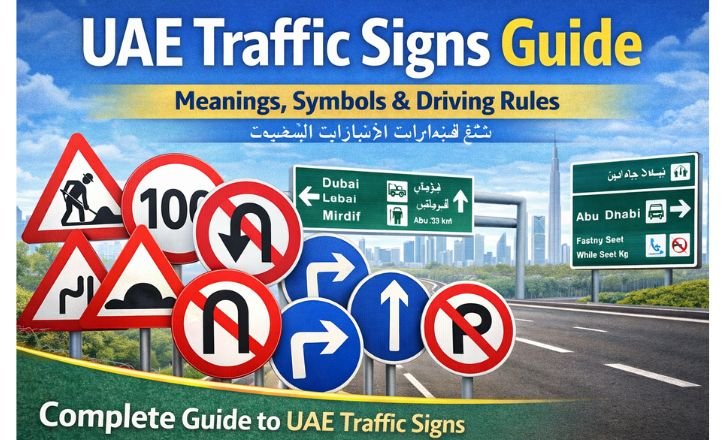
The UAE is an easy and contemporary experience when it comes to driving, except that you have to be thoroughly familiar with the traffic signs, symbols, and road markings that regulate the roads. Having a high-speed Sheikh Zayed Road to residential schools in Sharjah or Abu Dhabi, there are UAE traffic signs to maintain safety, efficiency, and clearance of the road for residents and tourists.
This guide on all the key types of UAE road signs and traffic signs, the correct reading of these signs, and why they are important, will enable you to save fines, minimize risk, and drive confidently in all the Emirates.
Why Understanding UAE Traffic Signs Is Essential
Legal Importance of Traffic Signs
UAE traffic signs have legal strength. A breach of a sign may be fined immediately or black pointed or the vehicle impounded without any human intervention as cameras automatically issue fines and black points.
Impact on Road Safety
The proper perception of cues minimizes accidents, particularly on high-speed roads and interchangeable networks. The use of signs will give prior warnings and directions so that the drivers can respond safely as opposed to driving abruptly.
Equal Rules for Residents and Tourists
The UAE traffic rules are uniform for locals, expatriates, and tourists. A foreign driving license does not allow the driver to escape punishment in case the traffic signs have been violated or misinterpreted.
UAE Traffic Signs at a Glance
The UAE traffic signs are designed according to a global standard, with Arabic and English being used to make them clear.
How Traffic Signs Are Categorized in the UAE
| Category | Purpose | Typical Shape / Color |
| Regulatory Signs | Enforce laws and rules | Circular / Red, Blue |
| Warning Signs | Alert drivers to hazards | Triangular / Yellow |
| Guide & Information Signs | Navigation and services | Rectangular / Green, Blue |
| Temporary Signs | Roadworks & diversions | Orange / Yellow |
| Road Markings | Lane and movement guidance | White / Yellow |
All the categories are employed to predictably and safely influence driver behavior.
Mandatory & Regulatory Traffic Signs: Rules You Must Follow
Mandatory Traffic Signs
Signs placed forcefully require drivers to take certain measures, like taking a particular road or a given speed limit. These signs are particularly widespread at the intersection points, tunnels, and the controlled sections of the roads.
Control Signs and Signals
Traffic movement and right-of-way are controlled by control signs. Traffic lights, stop signs, and give-way signs are included in this category and are strictly enforced by the enforcement cameras.
Freeway-Controlled Signs
On highways and expressways, there are controlled-access signs controlling entrance, exit, and lane discipline. The signs are essential on highways where making a hasty move may be hazardous.
Prohibitory & Parking Control Signs
Prohibitory Road Signs
These are indications of what is prohibited and may include:
- No U-turn
- No overtaking
- No entry
They are typically red-bordered and strictly enforced by cameras.
Parking Control Signs
Parking rules vary by Emirate and zone. Signs specify:
- Paid parking zones
- Time restrictions
- Resident-only parking
People of Determination (Reserved) Parking Signs
People of Determination have a legally secured reserved parking. The abuse might lead to hefty fines and towing of cars.
Key Takeaway
Parking signs in Dubai, Sharjah, and Abu Dhabi might be similar; however, enforcement regulations vary. The zone code and time limits must be read very carefully.
Warning Traffic Signs: Anticipate Road Conditions
The warning signs are meant to make the drivers respond in time to prevent accidents.
Standard Warning Signs
These alert drivers to:
- Sharp bends
- Pedestrian crossings
- Slippery roads
Advanced & Diagrammatic Warning Signs
On highways, diagram-based signs visually represent:
- Lane merges
- Exit layouts
- Upcoming interchanges
Hazard Marker Signs
Used near:
- Road edges
- Bridges
- Obstacles
They help drivers maintain alignment at high speeds or in poor visibility.
Guide, Direction & Information Signs
Directional and Trailblazing Signs
Direction lights are used to direct drivers in directions to cities, districts, and other major destinations. Airports, ports, and tourist landmarks are usually marked with trailblazing signs.
Advance Guide and Exit Signs
The signs used as advance guides are located long before an exit to enable proper positioning of lanes. Direction signs at departure prove that one has taken the right route.
Understanding Color-Coded Guide Signs
Navigation is made easy by color coding. Green signs normally point out highways, blue signages point out services, brown ones point out tourist attraction sites, and white signs point out local traffic.
Temporary, School Zone & Special-Purpose Signs
Temporary Road Signs
There are temporary signs in case of roadworks, diversion, or maintenance. These indicators can partially supersede permanent signage and should always be obeyed.
School Zone Signs
Speed limits are also reduced in school areas where speeds are signified with clear markings during a given time of the day. These are tight areas that are enforced because of children.
Variable Message and Weather Signs
Electronic signs give instant information concerning the speed limit, traffic jams, or weather, like fog or sandstorms.
Understanding UAE Road Markings & Pavement Symbols
Road signs complement traffic signs to control traffic and strengthen regulations. Road markings, in most instances, have similar legal power as signs.
Solid lines refer to the fact that the lane change or passing cannot be made or become restricted in any way, whereas broken line means it can be done whenever it is safe. Directional arrows, stop lines, and lane-use markings are used to direct the whereabouts of drivers at the intersections and merges.
There are warning signs like zig-zag lines or rumble strips that warn drivers about the impending danger or a change in speed. Guidance markings assist motorists in passing through the complicated interchanges by explicitly showing exit-only lanes or merging paths.
Curb & Kerb Paint Colours Explained
The colors of the Kerb paint offer fast visual information regarding the rules of parking and stopping. These are colors that one can easily ignore, but are strictly imposed, particularly in the urban centres.
| Kerb Color | Meaning |
| Red | No stopping or parking |
| Yellow | Temporary stopping allowed |
| White | Short-term parking |
| Blue | Paid parking zone |
One of the most widespread causes of drivers paying a fine for parking in the UAE is a misunderstanding of the colors of kerbs.
How to Read UAE Traffic Signs Like a Pro
Interpreting Signs Effectively
Effective interpretation entails perception of the color, shape, and position of a sign. Overhead signs are commonly used with the application to certain lanes, whereas roadside signs may be used in a broader way.
Speed Limits and Changing Conditions
During unfavorable weather or in special areas, there are possibilities of the speed limit being altered. These changes are communicated by electronic signs and are enforced as soon as they are.
Navigating Roundabouts and Interchanges
Interchanges and roundabouts are dependent on advanced signage. The fact that these signs are read early assists the drivers in choosing the right lane and prevents unexpected actions.
UAE Traffic Enforcement, Fines & Toll Systems
Smart Traffic Enforcement
The UAE has incorporated AI-based cameras that track speeding, broken lanes, and bad driving habits. The majority of the violations are automated.
Darb Toll Gate Signs
There are signs of toll zones and operating times in Darb, Abu Dhabi. These indications should be adhered to so as to evade unpleasant surprises.
Consequences of Unpaid Fines
Unpaid fines might deny one the opportunity to renew vehicle registration, and in severe cases, one may not be allowed to leave the country.
Conclusion:
Learning the traffic signs, symbols, and road markings in the UAE is a must, not an option, when it comes to driving safely and without stress. As a tourist, new resident, or skilled driver, these rules would allow you to be sure to avoid a fine, keep others safe, and enjoy the freedom of using the UAE roads without doubts.
Final Thought
The UAE has the safest drivers, not the fastest drivers.
FAQs About UAE Traffic Signs & Driving Rules
Are there any traffic signs similar to all Emirates?
Yes, in design–but there is a difference in the rules of enforcement and parking.
Are signs in Dubai in English?
The majority of the significant signs are bilingual (Arabic and English).
Can tourists drive in the UAE?
Yes, having a valid international license or a recognized foreign one.
Is Dubai strict on speeding?
Yes–all over with speed cameras and automated fines.



Leave a Reply