

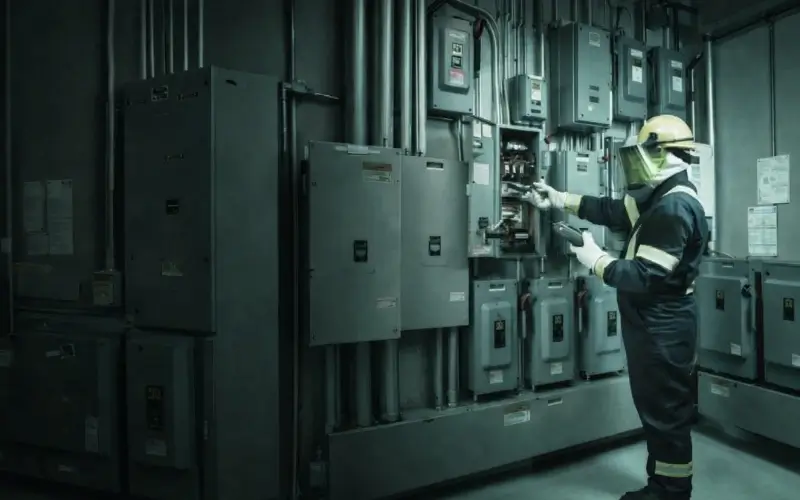
In the hierarchy of industrial hazards, few events are as violent or as potentially life-altering as an arc flash. An arc flash is a type of electrical explosion that results from a low-impedance connection through air to ground or another voltage phase in an electrical system. The result is a massive release of energy that creates temperatures reaching up to 35,000°F—hotter than the surface of the sun—along with a blinding flash, a deafening pressure wave, and the vaporization of metal components.
For any facility manager or owner, ensuring the safety of personnel who work on or near energized equipment is a moral and legal imperative. The primary tool for managing this risk is a comprehensive Arc Flash Study. This study provides the mathematical certainty needed to protect human life, specify correct safety gear, and ensure that the facility is compliant with international safety standards like NFPA 70E and IEEE 1584.
The Science of the Study: Quantifying the Blast
An Arc Flash Study is not a visual inspection; it is a rigorous engineering calculation. Its goal is to determine the “Incident Energy”—the amount of thermal energy that would be released at a specific distance from the equipment during a fault. This calculation depends on two primary factors: the magnitude of the fault current and the time it takes the protective device (breaker or fuse) to clear that fault.
To obtain these values, engineers must first perform a comprehensive power systems analysis. This foundational study creates a digital model of the entire facility, simulating short-circuit currents at every panel and switchboard. Without an accurate short-circuit analysis, an arc flash study is impossible, as the explosive energy is directly linked to the “available” power from the utility and on-site generation.
Why Every Industrial Facility Needs an Arc Flash Study
The results of the study manifest as safety labels on electrical equipment. These labels provide critical information to workers, including the “Arc Flash Boundary” (the distance at which a person could receive second-degree burns) and the required “Personal Protective Equipment (PPE) Category.”
Beyond labeling, the study identifies “High Incident Energy” locations. In many older facilities, engineers find panels where the available fault current is so high, or the breakers are so slow, that the incident energy exceeds the rating of even the heaviest arc-rated suits. Identifying these “Dangerous” zones allows management to implement engineering controls—such as remote racking or high-speed sensing—to reduce the risk to acceptable levels.
The Role of Commissioning and Maintenance
Safety is a moving target. A facility that was safe five years ago may be hazardous today due to changes in the utility grid or the aging of protective devices. If a circuit breaker is corroded and takes an extra 0.1 seconds to trip, the incident energy during an arc flash could double, turning a survivable event into a fatal one.
This highlights the importance of Electrical Construction & Commissioning Management. During the commissioning phase, protective relays and breakers are tested to ensure their trip times match the design specifications used in the Arc Flash Study. Furthermore, ongoing maintenance ensures that these critical safety components remain functional throughout the life of the plant. A study is only as good as the physical equipment it represents.
Read Also: Fuel Stations in the UAE
Improving Safety through Engineering Design
A modern Arc Flash Study doesn’t just identify hazards; it provides the roadmap to mitigate them. By adjusting protective device settings or upgrading to faster-acting fuses, engineers can often lower the incident energy level significantly without compromising system reliability. This practice, known as “Arc Flash Mitigation,” is a cornerstone of proactive industrial safety management.
Conclusion
Arc flash events are rare, but their consequences are devastating. An Arc Flash Study transforms the invisible threat of electrical energy into a quantifiable risk that can be managed through engineering and training. By investing in rigorous power system analysis and maintaining strict commissioning standards, industrial facilities can ensure that their most valuable assets—their people—return home safely at the end of every shift.
Frequently Asked Questions
- How often should an Arc Flash Study be updated?
According to NFPA 70E, the study must be reviewed at least every five years. However, it should be updated immediately if there are significant changes to the system, such as a new transformer, a change in the utility’s available fault current, or the addition of large motors.
- Is an Arc Flash Study required by law?
While many national laws don’t explicitly name “Arc Flash Study,” they require employers to provide a safe workplace and identify hazards. In practice, regulatory bodies and insurance companies treat NFPA 70E compliance as the standard for fulfilling this legal obligation.
- What is the “Arc Flash Boundary”?
The boundary is the distance from a potential arc source at which an unprotected person would receive a second-degree burn ($1.2 \text{ cal/cm}^2$). Anyone crossing this boundary while work is being performed must wear the specified PPE.
- Can I perform an Arc Flash Study myself using software?
While software is essential, the study requires professional engineering judgment. Incorrect data entry (like wrong cable lengths or breaker types) can lead to dangerously inaccurate results. It is highly recommended to use specialized engineering firms to ensure accuracy and liability protection.
- What is “Incident Energy”?
Incident energy is the amount of thermal energy (heat) that reaches a surface at a certain distance from an electrical arc. It is usually measured in calories per square centimeter ($\text{cal/cm}^2$).



Leave a Reply