
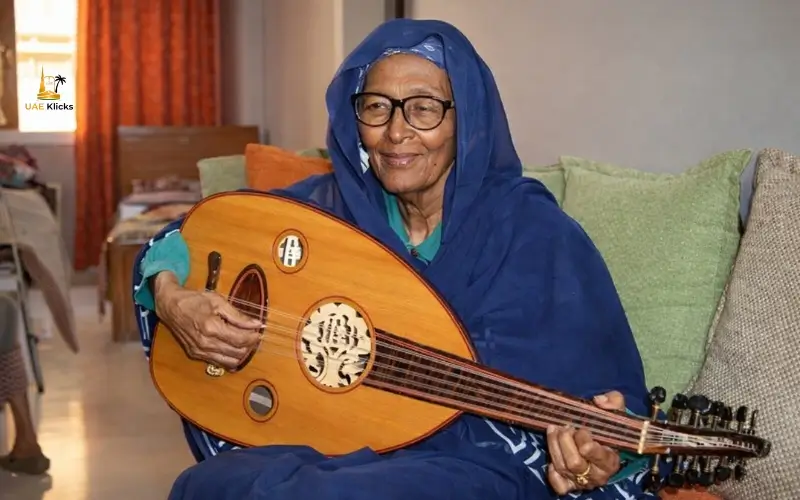
Asma Hamza is one of the most courageous and influential figures in Arab history. Her life is a testament to her resilience, creativeness, and quiet talent. She was a pioneering female composer at a time when men dominated music composition.
Provides a biography that is complete, optimized for search, and goes beyond the basic facts. Explores her childhood, musical journey, struggle, philosophy, as well as the cultural legacy which continues to influence Sudan and the Arab World today.
Asma Hamza – Quick Biography Overview
| Category | Details |
| Full Name | Asma Hamza Bashir |
| Known As | Asma Hamza |
| Birth Year | 1932 |
| Birthplace | Halfaia Al-Malaki, Sudan |
| Nationality | Sudanese |
| Profession | Music Composer, Oud Player |
| First Instrument | Oud |
| Musical Training | Self-taught |
| Career Start | Composed music secretly in early years |
| Breakthrough Moment | Won Laylat al-Qadr Al-Kubra (1997) |
| Famous Composition | Al Zaman Al-Tayb (1983) |
| Total Works | More than 90 musical compositions |
| Musical Style | Sudanese folk blended with Arabic classical |
| Major Challenge | Gender bias in male-dominated music field |
| Recognition | Google Doodle Tribute (2023) |
| Legacy | First female composer in Sudan, pioneer for women |
| Death | May 21, 2018 |
Early Childhood and Cultural Background
Asma Hamza was born in Halfaia Al-Malaki in Sudan in 1932. She grew up within a conservative social environment, where women were not encouraged to pursue their artistic goals. Despite the limitations of her home, music was present in the form of oral traditions, folk song, and poetry storytelling.
She developed a deep inner life as an only child. Sound and imagination were her constant companions. Music was an integral part of the community’s life in Sudan during this time, despite its cultural environment being shaped by colonial transition and tradition. These early influences quietly shaped the musical instincts of her.
Find Music without Formal Education
Asma Hamza, unlike many other artists, did not receive formal music training. Her music education was completely self-driven. She studied music by memorizing tunes, listening to radio programs, and experimenting.
Her first instrument was an oud, the traditional Arabic string instrument. She learned to play the oud by ear and developed a keen sense of rhythm and pitch. This phase of self-discovery defined her style – intuitive, emotional and deeply connected with cultural memory.
She dreamed about singing as a child but soon realized that her voice was not very good. She did not give up. Instead, she turned her passion for composition and instrumental performance. This decision would define her historical role.

Early Struggles & Social Resistance
Women composing music in the Sudan of the mid-20th century was socially unacceptable. Asma Hamza was not only resisted by society, but also cultural institutions who rarely recognized female creators.
She composed her music initially in secret to protect herself. Early works were often shared in secret, without her name. The concealment of her early works was not due to a lack in confidence, but rather a strategy for survival in a restrictive setting.
Despite her challenges, her talent slowly gained recognition from musicians who respected her emotional depth and her originality in her compositions.
Breakthrough and Recognition
In 1997, she became a major figure in the music world when she won Laylat al-Qadr Al-Kubra. This accomplishment brought her to the forefront of public attention and established her as a composer with exceptional abilities.
In 1983, she composed Al Zaman Al-Tayb which was performed later by Sudanese artist Sumaya Hassan. This composition showed her ability to combine Sudanese rhythms and classical Arabic melodic structure.
Asma Hamza no longer worked in isolation. She was now a respected artist in a space dominated by men.
Musical Styles and Artistry Philosophy
Her musical style was defined more by emotional honesty than by technical complexity. She felt that music should express feelings without ornamentation.
Her style is characterized by:
- Fusion of Sudanese Pentatonic Scales with Arabic Maqamat
- The foundations of poetry
- The emphasis is on melody rather than performance
- Silence as an emotional tool
She saw music as an universal language that transcended gender and social norms. The oud wasn’t just a musical instrument, but also a way to bridge cultures and generations.
Read Also: Ramneek Sidhu
Personal Values and Life Style
Asma Hamza managed to balance her artistic career with her family obligations. Her father’s support was crucial to her early development. This was especially true at a time when women were rarely encouraged in music.
Later, she became a mom while continuing to work as a musician. Her philosophy was centered around humility, cultural preservation and artistic honesty. Her goal was not fame, but expression.
The Challenges that Defined her Strength
The cost of breaking down gender barriers was personal. She suffered criticism, was isolated, and had limited opportunities to perform. These struggles helped her to become resilient.
She let her music do the talking, rather than directly confronting society. With time, the public’s perception changed from skepticism into admiration. She became a model of artistic perseverance, and a quiet revolution.
Google Doodle: International Recognition
Google will honor her in July 2023 with a special Google Doodle that celebrates her contributions to gender equality and music. This recognition brought her story to millions of people who had never heard it before.
Her work has a lasting artistic and social impact that transcends national boundaries, as cultural historians knew.
Legacy and Cultural Impact
Asma Hamza’s influence goes beyond her compositions. She opened doors to women in Arab composition of music, proving creative authority does not depend on gender.
Her legacy includes:
- Women composers inspiring future generations
- Conserving Sudanese music identity
- African and Arab music traditions
Her work is now discussed in academic circles, cultural forums and artistic circles throughout the Arab World.
The Later Years and the Passing
In her later years, she spent time mentoring young musicians and perfecting her craft. Asma Hamza died on May 21, 2018 in Halfaia. She left behind a body of work that resonates.
Her death was not only mourned as a loss of an Arab artist, but also as the closure of a groundbreaking chapter in Arab history.
Conclusion:
Asma Hamza’s story is more than just music. It is a story about courage and art. Her journey from a conservative Sudanese culture to international recognition demonstrates how creativity can challenge social norms without confrontation.
Her life is proof that talent combined with patience and conviction can redefine history. Her music and legacy continues to inspire artists, scholars and dreamers of all generations.
FAQ
Who was Asma Hamza ?
She was the pioneering Arab composer and first female in Sudan.
Why is she so important?
She broke down gender barriers in music and changed the cultural attitude towards women musicians.
What makes her music so unique?
The music is a blend of Arabic classical melody and Sudanese folk tune.
Is she a recognized international figure?
Yes, we will include a Google Doodle in 2023.
What is her legacy to the world?
Women artists can be empowered, inspired, and their culture preserved.
